How to Handle High Flow Water Demand in Solar Farm Cleaning
Your cleaning crew is ready, but your small water purifier can’t keep up. The job stalls, wasting labor and time while you wait for the tank to fill.
Handle high flow demand by using a system built with high-flow filter cartridges for pre-filtration, appropriately sized Reverse Osmosis (RO) membranes, and a buffer tank with a delivery pump. This ensures a continuous, high-volume supply of pure water directly to your cleaning crews.
I remember visiting a massive, newly-built solar farm in an arid region. They had invested in state-of-the-art robotic cleaners that could wash panels at an incredible speed. But the robots were barely moving. I found out their water purification system was a small, under-sink RO unit they had repurposed. It could only produce a tiny fraction of the water the robots needed. They had a high-tech solution crippled by a low-flow bottleneck. This experience really highlighted that for large-scale operations, the water delivery system is just as important as the water quality itself.
What are the main challenges of supplying water for large-scale solar cleaning?
You need thousands of gallons of pure water in a remote field with no infrastructure. The only source is a silty well, making logistics a nightmare.
The three main challenges are water volume, logistics, and source quality. You must produce a large quantity of pure water quickly, transport it efficiently across a vast area, and reliably filter a poor-quality source like well water without constantly clogging your system.
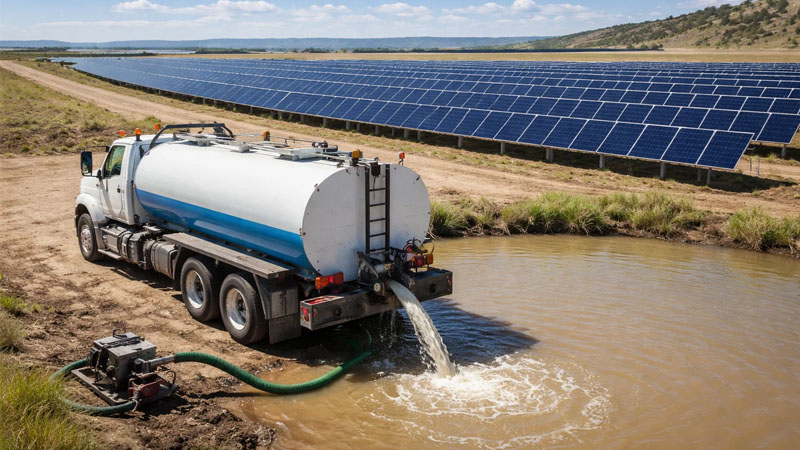
When you move from cleaning a small rooftop installation to a utility-scale solar farm, the problems change completely. It becomes a heavy industrial operation, and you face three distinct challenges that can stop your project cold if you are not prepared.
The Sheer Volume of Water
The first challenge is simply the enormous scale. A large solar farm can have hundreds of thousands of panels. Even if you use just a gallon or two of water per panel, the total volume required is massive. You need a system that can produce thousands of gallons of pure water per day, not just a few gallons per hour.
The Logistical Puzzle
The second challenge is getting that water to where it is needed. Solar farms are often in remote locations with no access to municipal water lines or even reliable power. The system needs to be mobile, often mounted on a truck or trailer. You also need to manage long hose runs and provide enough pressure to reach every panel on the site efficiently.
Poor Source Water Quality
Finally, the source water itself is often a huge problem. You might be drawing from a well, a pond, or a water truck. This water is often high in Total Dissolved Solids (TDS) and, more importantly, high in suspended solids like silt, sand, and organic matter. This dirty water will quickly destroy expensive RO membranes if not filtered properly beforehand.
How do High-Flow filtration systems meet these on-site demands?
Your water system keeps shutting down from clogged pre-filters. The crew has to stop and change out small, standard cartridges, completely killing your workflow and efficiency.
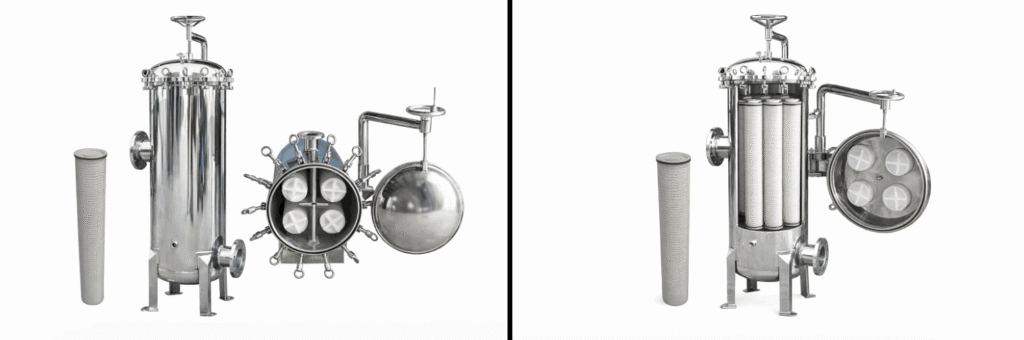
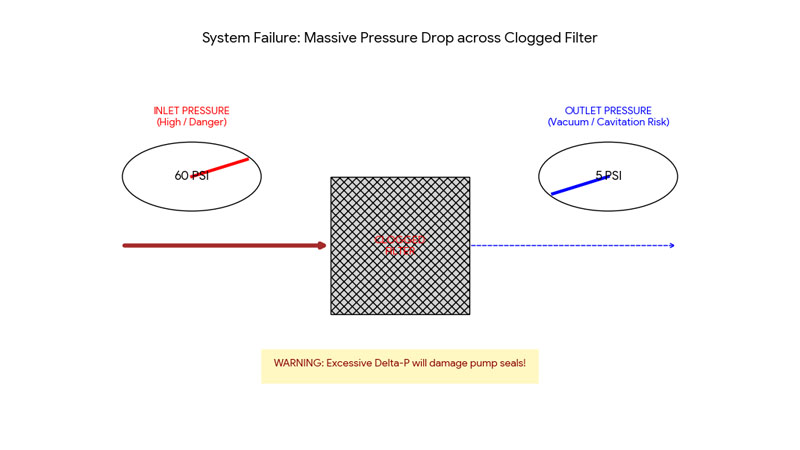
High-Flow systems use large-diameter, pleated filter cartridges. Their massive surface area handles high volumes of water with minimal pressure drop. This design gives them a huge dirt-holding capacity, meaning longer service intervals and a more reliable, continuous flow of water.
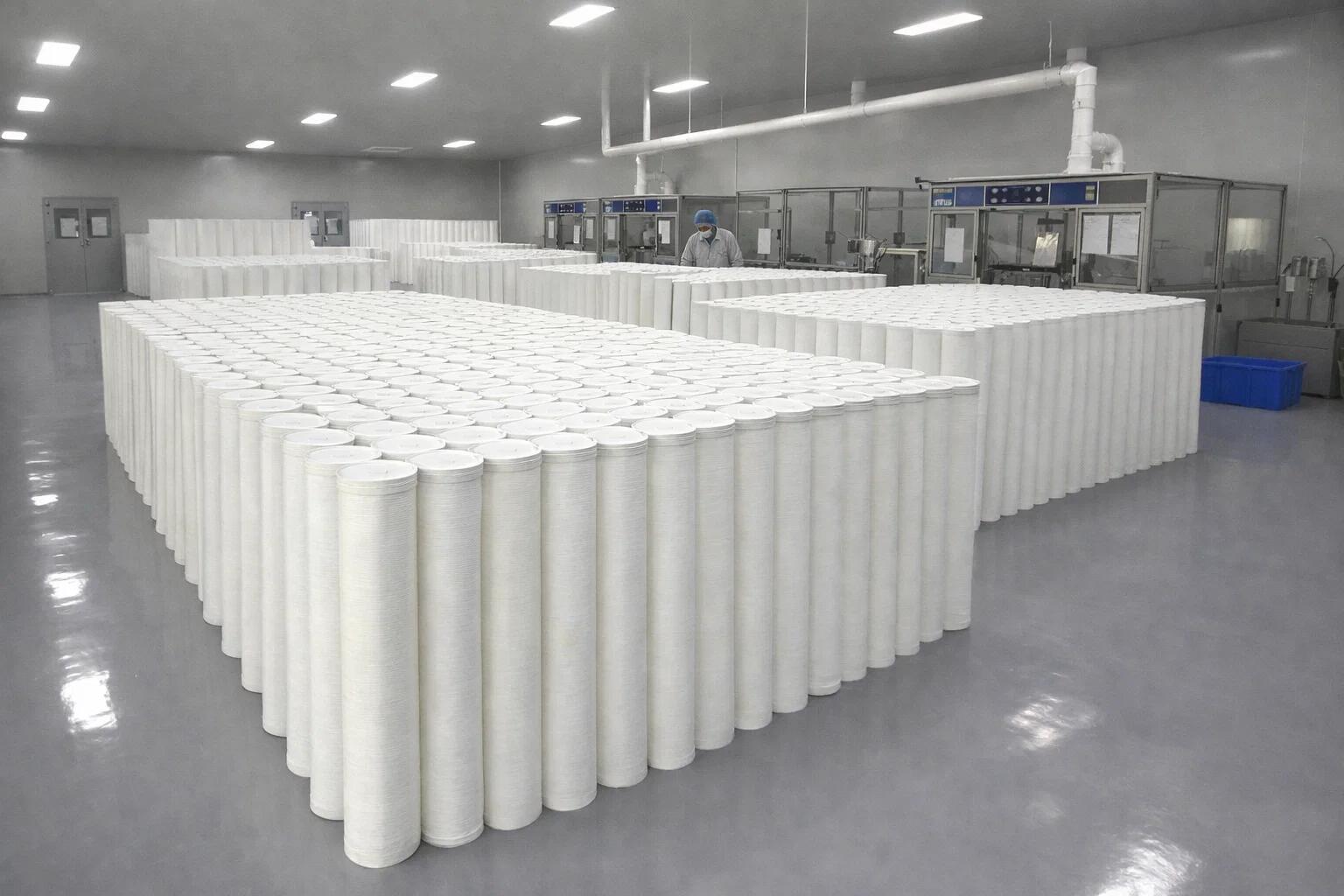
This is where my own expertise in industrial filtration really comes into play. The pre-filtration stage is the unsung hero of any large-scale water treatment system. When dealing with high volumes of dirty source water, standard 2.5-inch filter cartridges are simply not up to the task. They have a small surface area and clog very quickly, which creates a maintenance bottleneck. High-Flow cartridges solve this problem. Their large 6-inch diameter and pleated media design offer an enormous surface area. This allows them to process much more water at a lower pressure, which is critical for the efficiency of the main RO system. More importantly, they have a massive dirt-holding capacity. They can capture and hold far more sediment before they need to be replaced, which means the system can run for hours or even days without interruption.
High-Flow vs. Standard Filter Cartridges
| Feature | Standard Cartridge (2.5") | High-Flow Cartridge (6") |
|---|---|---|
| Typical Flow Rate | 5 – 10 GPM | 300 – 500 GPM |
| Dirt-Holding Capacity | Low | Very High |
| Pressure Drop | High | Very Low |
| Service Life | Short | Long |
| Ideal Application | Low-flow, clean water | High-flow, high-sediment water |
What are the key components of a mobile high-flow water treatment system?
You want to build a mobile water treatment unit but are unsure of the right parts. Guessing could lead to an expensive system that fails in the field.
A mobile system needs an inlet pump, a High-Flow pre-filter housing, a high-capacity RO unit, a buffer tank for pure water storage, and a delivery pump to send the water to the cleaning crew.
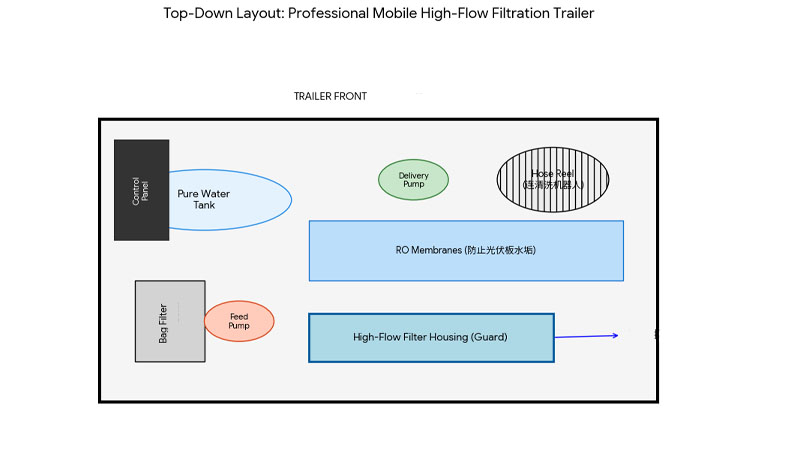
Building a reliable mobile system is about creating a logical process chain. Each component has a specific job and must be sized correctly to work with the others. Here is the typical flow of a well-designed system.
1. Inlet Pump
This pump draws water from your source (like a well or storage tank) and feeds it into the system. It needs to provide enough pressure to push the water through the pre-filter.
2. High-Flow Pre-Filtration
This is a housing containing one or more High-Flow filter cartridges. Its only job is to remove all the sand, silt, and sediment. This protects the most expensive and sensitive part of the system: the RO membranes.
3. High-Capacity RO System
This is the core of the purification unit. It uses high pressure to force the pre-filtered water through RO membranes, removing over 99% of the dissolved solids (TDS) and producing pure water. The system’s capacity is measured in Gallons Per Minute (GPM) or Gallons Per Day (GPD).
4. Pure Water Buffer Tank
This is a critical component that many people overlook. The RO system produces pure water at a steady, fixed rate. The cleaning crew, however, uses water in bursts. The buffer tank decouples these two things. The RO system can run continuously to fill the large tank, and the crew can draw water from it at a very high flow rate whenever they need it.
5. Delivery Pump
This pump takes the pure water from the buffer tank and sends it through long hoses to the cleaning wands or robotic cleaners. It provides the high pressure and flow needed for effective cleaning.
Conclusion
To clean solar farms efficiently, use a mobile system with High-Flow pre-filters and a buffer tank. This setup ensures a continuous supply of pure water, maximizing uptime.