How does Gradient Density technology achieve a longer service life?
Your standard filters are clogging up prematurely, causing frequent, costly change-outs. You need a filter that utilizes its full depth, not just the surface, to extend its life.
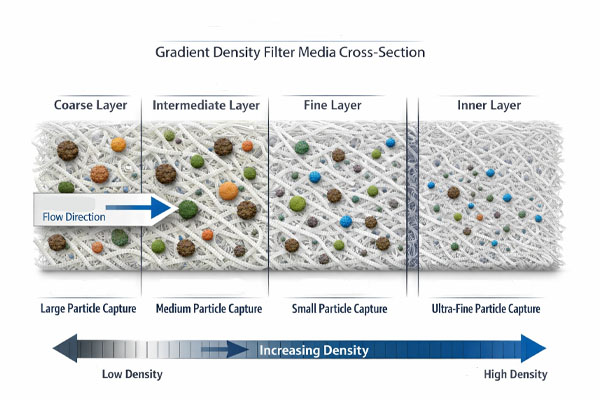
Gradient density media uses larger pores on its outer surface to catch big particles and smaller pores on the inside for fine particles. This multi-layer structure utilizes the full depth of the filter, maximizing dirt-holding capacity and dramatically extending its service life.
I remember working with a desalination plant that was frustrated with their pre-filter performance. They used standard 5-micron filters that would clog in less than a week. We cut one open, and it was a perfect illustration of the problem: only the outer millimeter of the filter media was caked with dirt, while the inside was perfectly clean. They were throwing away filters that were 90% unused. This is the exact problem that gradient density, or "graded-pore," technology was invented to solve. It’s about making the entire filter work harder, not just the surface.
What is the problem with single-density filter media?
Your standard filters blind off almost instantly, leading to a rapid pressure spike. This wastes media and money because the filter is clogged long before it’s actually full.
Single-density media has pores of a uniform size. Large particles quickly cake the outer surface, blocking smaller particles and fluid from reaching the inside. This "surface blinding" means most of the filter’s depth goes unused, causing premature clogging.
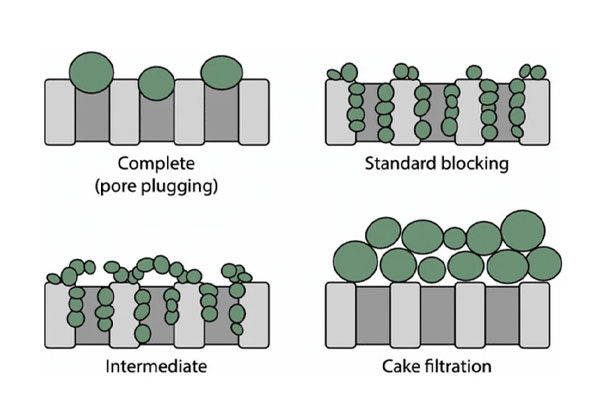
Think of a standard, single-density filter like a single-lane road. The filter media has pores that are all roughly the same size from the outside to the inside. When your fluid, which contains a mix of large and small particles, hits the filter, the largest particles get stuck right on the surface. Very quickly, these large particles build up and form a layer of "cake" that blocks the entrance to the pores. We call this "surface blinding" or "surface loading." Once this happens, the fluid can no longer reach the clean, perfectly good filter media on the inside. The pressure drop across the filter spikes, your alarm goes off, and you have to change the filter. The problem is that the filter isn’t truly full; it’s just blocked at the surface. You’ve paid for a whole filter but have only used a tiny fraction of its total capacity.
How does the gradient structure capture particles more efficiently?
Your process fluid contains a mix of large and small particles. How can one filter effectively capture all of them without immediately clogging with the biggest contaminants?
The gradient structure acts like a built-in pre-filter. Its open outer layers capture large particles, while the tighter middle and inner layers progressively remove smaller ones. This classifies and stores contaminants throughout the filter’s depth, maximizing efficiency.
A gradient density filter is much smarter in its design. Instead of one single-lane road, it’s like a multi-lane highway that gradually narrows. The outer layer of the filter has large, open pores. This section acts as a dedicated pre-filter, easily capturing the largest particles without clogging. The fluid then continues to the middle layers, where the pores get progressively tighter. These layers capture the medium-sized particles. Finally, the fluid reaches the dense inner core, which has the smallest pores to capture the finest silt and sediment. This step-by-step classification allows the filter to use its entire depth to capture and store dirt. By trapping the big "boulders" on the outside and the fine "sand" on the inside, it prevents surface blinding and keeps pathways open for fluid to flow. The result is a much more gradual increase in pressure and a filter that can hold many times more dirt than a standard one before it needs replacement.
Particle Capture Comparison
| Filter Type | Particle Capture Method | Resulting Service Life |
|---|---|---|
| Single-Density | Surface Loading (Blinding) | Short & Unpredictable |
| Gradient Density | Depth Loading (Classification) | Long & Predictable |
What are the main benefits of a longer filter life?
Replacing filters costs money, but the real expense is often hidden. What is the true value of doubling or tripling the time between filter change-outs for your plant?
A longer service life means fewer filter purchases, reduced labor costs for change-outs, and minimized production downtime. It also leads to less waste and a lower overall cost of ownership, making your entire filtration process more efficient and predictable.
When you switch to a filter that lasts three or four times longer, the most obvious benefit is buying fewer cartridges. That’s a direct saving on your consumable budget. But in my experience, that’s just the tip of the iceberg. The real value comes from the operational improvements. First, there’s the labor cost. Every filter change-out requires a technician to stop what they’re doing, get the parts, perform the replacement, and restart the system. Fewer change-outs means your maintenance team can focus on more critical tasks. The biggest benefit of all is often the increase in production uptime. In many industries, shutting down a process line to change filters, even for an hour, can result in thousands of dollars in lost production. A predictable, long-lasting filter minimizes these interruptions. When you add it all up—consumables, labor, uptime, and even reduced disposal costs—the total cost of ownership for a gradient density filter is significantly lower.
Conclusion
Gradient density technology extends filter life by using the entire media depth to capture particles. This reduces costs, labor, and downtime for a more efficient and reliable filtration system.