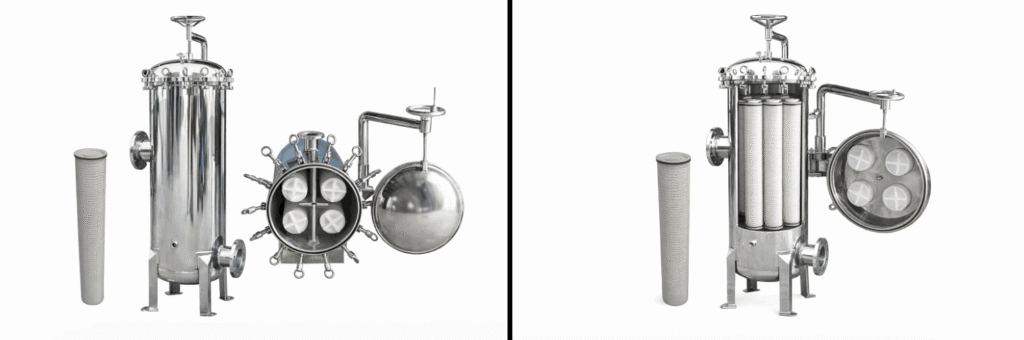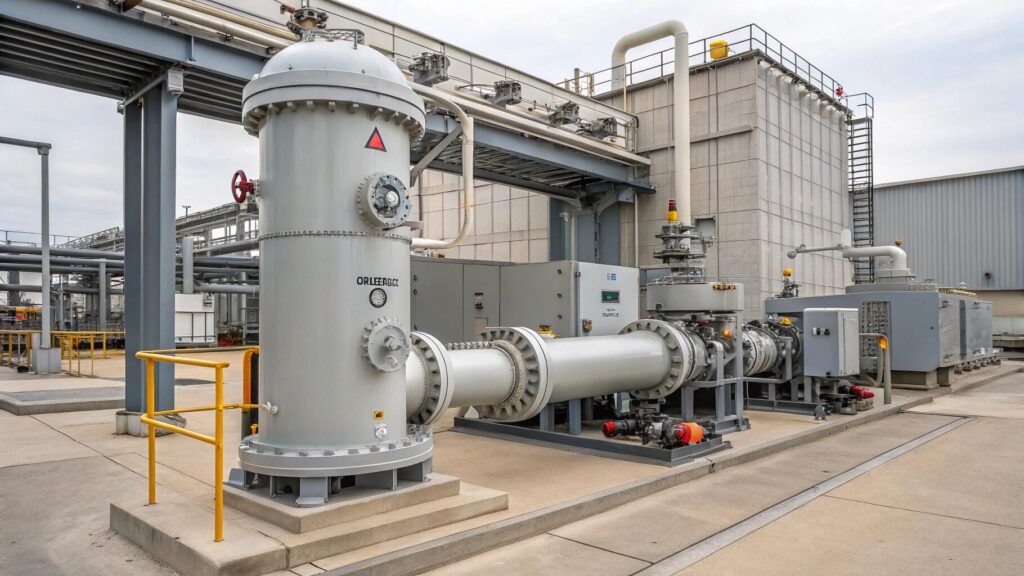
High Flow Filtration Challenges in Solar Panel Cleaning (And Solutions)
Your mobile filtration system works perfectly one day and fails the next. Unpredictable water quality is causing surprise shutdowns, leaving your crews idle and your projects behind schedule.
To solve these challenges, you need a strategy that includes staged filtration using absolute-rated filters, active monitoring of water quality, and optimizing your system’s flow rate to maximize the service life of your high-flow cartridges.
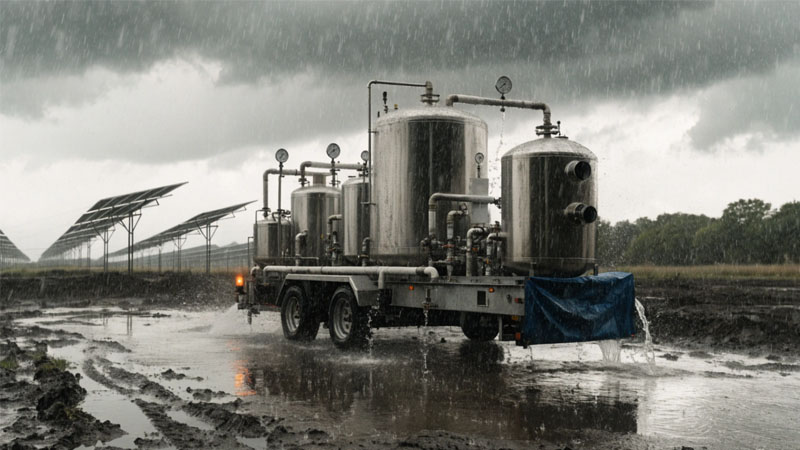
I’ll never forget a project in West Texas where we were cleaning a 100-megawatt solar farm. The water source was a large agricultural pond. For the first week, everything ran like clockwork. Then, an overnight thunderstorm hit. The runoff turned our clear pond into a muddy mess. The next morning, our High-Flow pre-filters, which had been lasting for days, were clogging in less than an hour. The entire operation ground to a halt. That day taught me a hard lesson: a successful high-flow system isn’t just about having big filters; it’s about having a smart strategy that can adapt to the worst-case scenario.
Why is consistent particle removal so difficult?
Your system uses a 5-micron filter, but you still see fine silt fouling your RO membranes. You are using the right rating, but your expensive equipment is still at risk.
The difficulty lies in the difference between "nominal" and "absolute" filter ratings. A nominal filter might let significant amounts of 5-micron particles pass, while an absolute filter guarantees their removal.
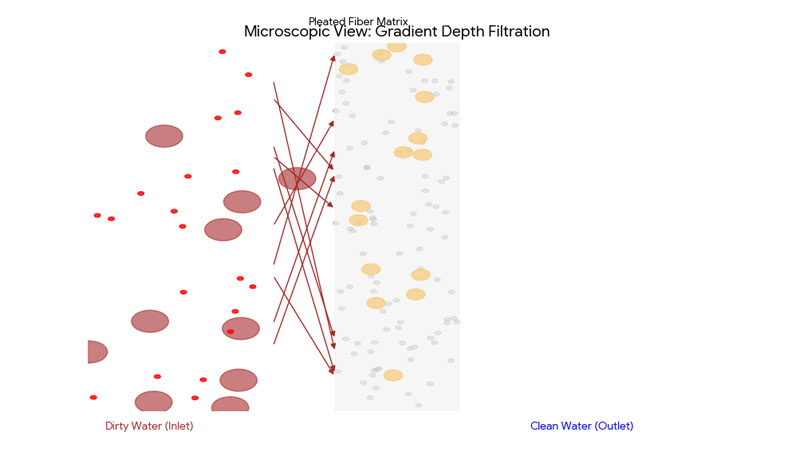
This is one of the most common and costly misunderstandings I see in the field. When you are trying to protect sensitive equipment like RO membranes, the details of your filter’s performance are critical. The problem is that not all filters with the same micron rating are created equal. They perform very differently based on how that rating is determined.
Nominal vs. Absolute Ratings
A nominal rating is more of an average. A 5-micron nominal filter might remove 85% or 90% of particles that are 5 microns or larger. That sounds good, but it means 10% to 15% are still getting through. When you are processing thousands of gallons of water, that small percentage adds up to a huge amount of damaging silt. An absolute rating, on the other hand, is a guarantee. An absolute-rated 5-micron filter is certified to remove at least 99.9% of particles 5 microns or larger. For protecting critical and expensive downstream equipment, this level of guaranteed performance is not a luxury; it is a necessity. I always tell engineers like Jacky that using a nominal filter to protect an RO system is like hiring a security guard who only shows up 90% of the time.
| Feature | Nominal Rating | Absolute Rating |
|---|---|---|
| Definition | Removes a percentage of particles at a given size (e.g., 90% of 5 microns) | Removes at least 99.9% of particles at a given size |
| Performance | Inconsistent, allows some larger particles through | Highly consistent and reliable |
| Best Use | Non-critical applications, pre-filtering for a second stage | Protecting sensitive equipment (RO membranes, pumps) |
| Cost | Lower | Higher (but cheaper than replacing membranes) |
How do you manage fluctuating water quality?
Your clear well water turns cloudy and full of sediment after a heavy rain. Your single-stage filtration system, designed for clean water, is instantly overwhelmed and fails completely.
Manage fluctuating water quality with a multi-stage filtration system. Use a coarser filter first to remove large debris, followed by a finer High-Flow cartridge to handle silt, protecting your final stages.
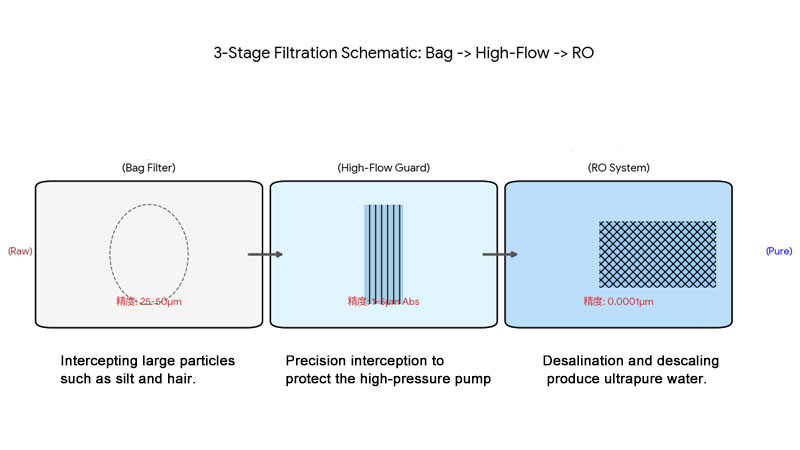
Many operators think the goal is to push as much water as possible through the system as fast as possible. This is almost always a mistake. Optimizing for filter life, not just speed, will save you a huge amount of money in the long run. There are two key levers you can pull to achieve this.
First, control your flow rate. Running a filter at its maximum rated flow is very inefficient. The high velocity tends to drive particles deep into the filter media, clogging it much faster. By slowing down the flow rate, you allow the filter to capture particles more evenly across its entire surface area. This can often double or triple a filter’s life with only a small reduction in overall speed. Second, you must use pressure to measure the filter’s life, not time. The true indicator that a filter is full is the differential pressure (or Delta-P), which is the difference in pressure between the inlet and the outlet of the filter housing. A clean filter might have a Delta-P of 2-3 PSI. A full filter might be at 15-20 PSI. By installing gauges and changing the filter based on this pressure reading, you ensure you are using 100% of its dirt-holding capacity.
| Strategy | Wrong Way (Expensive) | Right Way (Cost-Effective) |
|---|---|---|
| Flow Rate | Run pump at 100% of filter’s max flow | Operate at 60-80% of max flow |
| Change-out Trigger | Change filter every Monday (Time-based) | Change when Delta-P reaches 15 PSI (Condition-based) |
| Filtration | Use a single fine filter for everything | Use a multi-stage system (coarse then fine) |
Conclusion
Solve high-flow filtration issues with a smart strategy: use absolute-rated filters in a multi-stage setup, and optimize flow and pressure to maximize the life of your equipment.