1. The "Catalog" Myth: Why Nominal Flow is a Trap
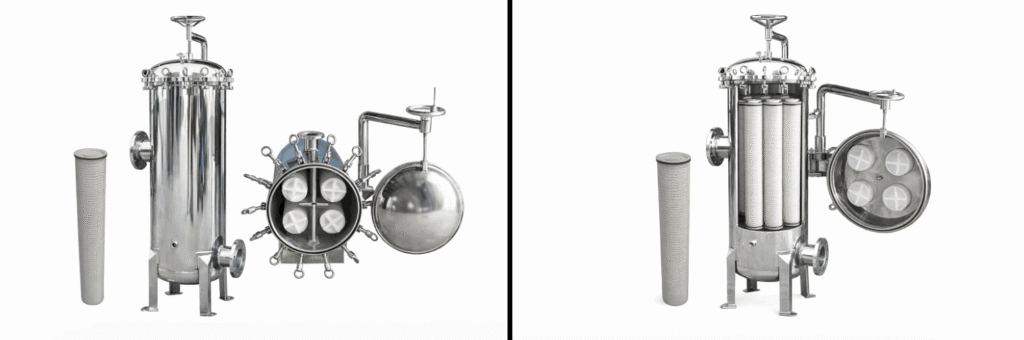
Filter manufacturers often advertise a standard 40-inch high-flow cartridge with a flow rate of 80 m³/h (or 350 GPM).
- The Trap: That number is achieved using 20°C pure RO water with zero dirt, targeting a starting differential pressure (ΔP) of just 0.1 Bar.
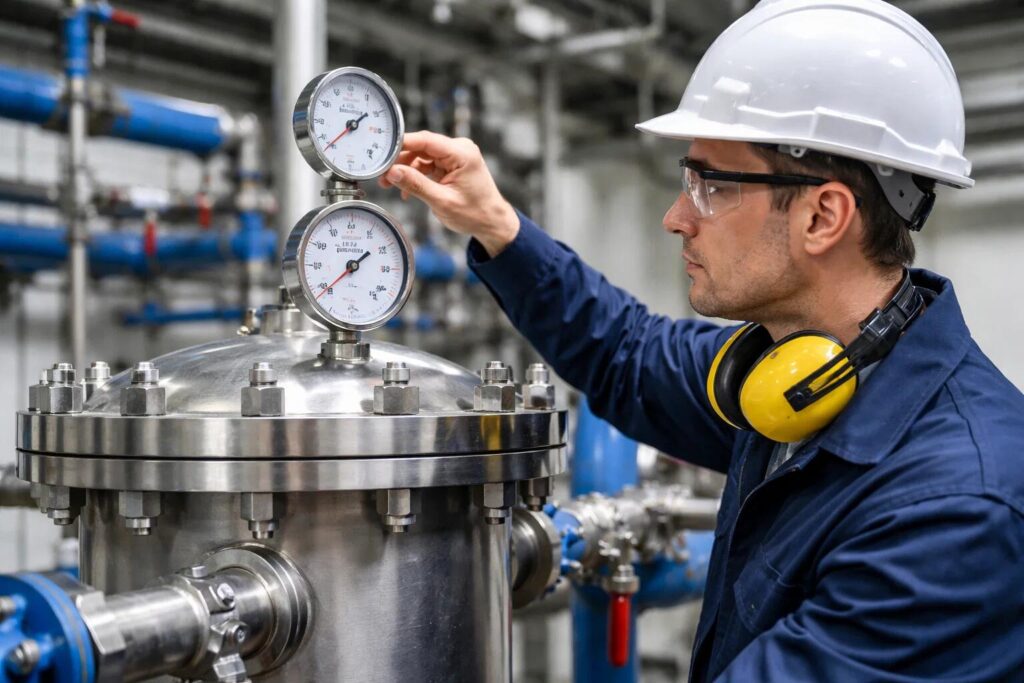
- The Reality: You are not filtering pure water. You are filtering Cooling Water, Amine, or Desalination Intake. If you push 80 m³/h of dirty water through that single cartridge, the Flux Density (velocity per square meter of media) is so high that particles act like bullets. They smash into the pleats, compact immediately, and cause Surface Blinding.
2. The Field Engineer’s Calculation Formula
To calculate how many filters (and how big of a housing) you actually need, you must use Derating Factors.
Here is the standard engineering formula used to prevent premature blinding:
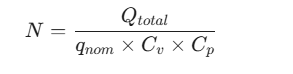
- N Total: number of cartridges required.
- Q-total: Your system’s total flow rate (e.g., 200 m³/h).
- q_nom: The filter’s catalog nominal flow rate (e.g., 80 m³/h).
- C_v: Viscosity Factor. (For cold water it is 1.0. For heavy oil or cold Amine, it drops to 0.4 – 0.6).
- C_p: Particulate Load Factor. (For < 1 ppm TSS, it is 1.0. For heavy crud bursts or > 10 ppm TSS, it drops to 0.4 – 0.5).
The Result: If you have heavy silt (C_p = 0.5), that "80 m³/h" filter is now only capable of handling 40 m³/h. You need twice as many filters to achieve a healthy OPEX.
3. The "Sweet Spot" (CAPEX vs. OPEX)
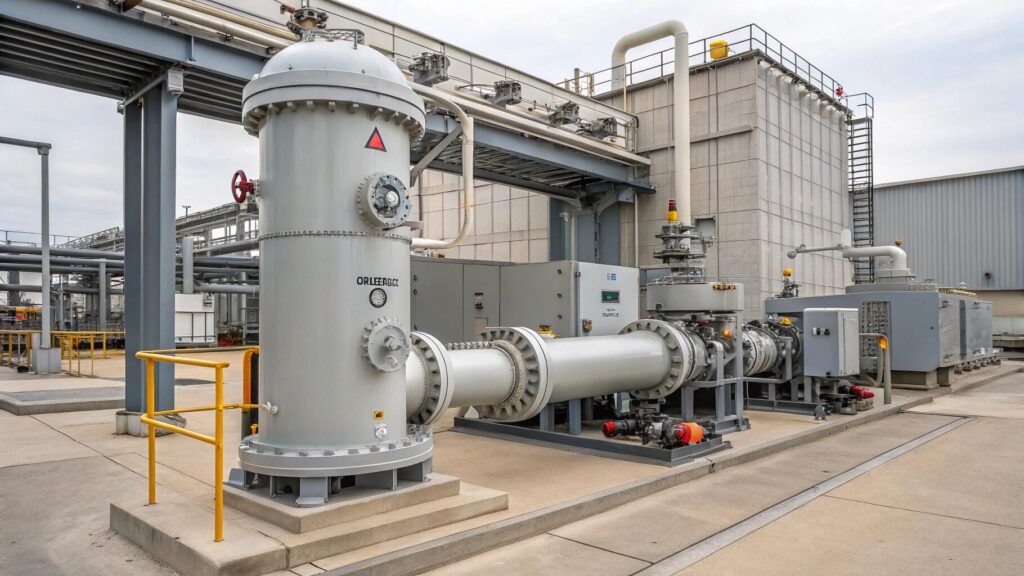
Undersizing your filter vessel saves you $5,000 on initial CAPEX, but costs you $50,000 a year in replacement filters (OPEX).
The secret to long filter life is Low Flux Density. By spreading the flow over a massive surface area, particles form a porous, breathable cake layer instead of an impermeable wall.
4. The ecofiltrone Solution: Maximum Media, Minimum Stress
If your current system was undersized by the designer, you cannot easily add more housings. Your only option is to increase the surface area and dirt-holding capacity per cartridge.
This is exactly what ecofiltrone engineers do. We manufacture drop-in replacements for Pall, Parker, and 3M housings that are designed for real-world flux rates:
- ✅ Deep-Pleat Technology: We pack up to 30% more effective surface area into the exact same cartridge dimensions.
- ✅ Gradient Density: Our media catches dirt throughout the entire depth of the filter, absorbing the high-velocity shock that blinds standard surface filters.
- ✅ Guaranteed Savings: By reducing the flux stress on the media, our cartridges typically outlast standard OEM replacements, cutting your annual spend by 40-60%.
Stop doing the math with fake catalog numbers.
📩 Action Required:
What is your total flow rate and fluid type?
Send me your parameters or your current OEM Part Number via DM. The ecofiltrone engineering team will run the derating calculations for you and provide an optimized, high-capacity replacement quote within 24 hours.