Designing a High Flow Water System for Solar Panel Cleaning
Designing a mobile water system seems complex. A wrong component choice leads to field failures, wasted money, and a system that can’t keep up with the job.
A successful design starts with calculating your total water demand. Then, you size the RO system, select High-Flow pre-filters to protect it, and choose pumps that match the required flow and pressure. Finally, you arrange these components logically on a trailer for efficiency.
I once visited a cleaning operation that was having constant issues. They had all the right parts, but nothing worked together. They had a massive, expensive delivery pump, but it was being fed by a tiny RO system that couldn’t produce water fast enough. The pump was constantly running dry. On the other hand, their pre-filter was far too small for the source water pump they were using. It was like they bought a race car engine, the tires from a bicycle, and the fuel tank from a lawnmower. This experience taught me that great components are useless without a great design that makes them work together as a single, efficient machine.
How do you determine the required flow rate?
Guessing your water needs is a recipe for failure. An undersized system stalls your crew, while an oversized one is a huge waste of capital investment.
Calculate the flow rate of your cleaning tools (e.g., 2 GPM per water-fed pole). Multiply this by the number of operators working at once. Add a 20% safety margin to find your required pure water delivery GPM.
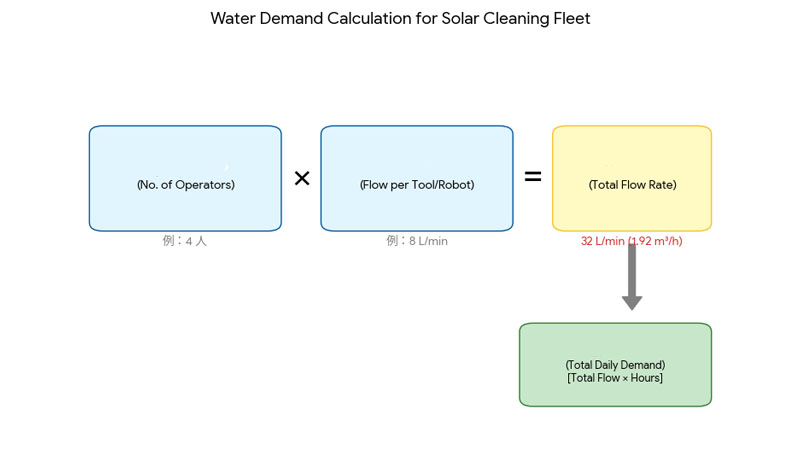
Everything in your system design starts with one number: the Gallons Per Minute (GPM) of pure water you need to deliver to the solar panels. Getting this number right is the most critical first step.
Start with Your Cleaning Tools
Every piece of cleaning equipment has an optimal flow rate specified by the manufacturer. A typical water-fed pole might use 1.5 to 2 GPM to clean effectively. A robotic cleaner might need 5 GPM or more. This is your base number.
Factor in the Number of Operators
Next, determine how many people will be cleaning at the same time. If you plan to have three operators using 2 GPM poles simultaneously, your peak demand is 3 operators x 2 GPM = 6 GPM.
The Importance of the Buffer Tank
This is where many people get confused. Your 6 GPM peak demand does not mean you need a 6 GPM RO system. Your RO system’s job is to fill a large buffer tank. Your delivery pump’s job is to pull from that tank to meet the 6 GPM peak demand. This allows you to use a smaller, less expensive RO system that runs continuously, saving a lot of money. For a 6 GPM peak demand, a 2 or 3 GPM RO system is often perfect.
| System Component | Role | Required GPM (Example) |
|---|---|---|
| RO System | Fills the buffer tank | 2 – 3 GPM |
| Buffer Tank | Stores pure water | 200+ Gallons |
| Delivery Pump | Meets peak cleaning demand | 6 GPM + 20% = 7.2 GPM |
How do you select the right pumps?
Choosing a pump feels overwhelming. The wrong one will fail to provide enough pressure or will be completely mismatched for the job, causing constant problems in the field.
Select two pumps. A low-pressure, high-volume ‘feed pump’ to push source water through the pre-filters, and a high-pressure, multi-stage ‘delivery pump’ to send pure water from the buffer tank to the cleaning crews.
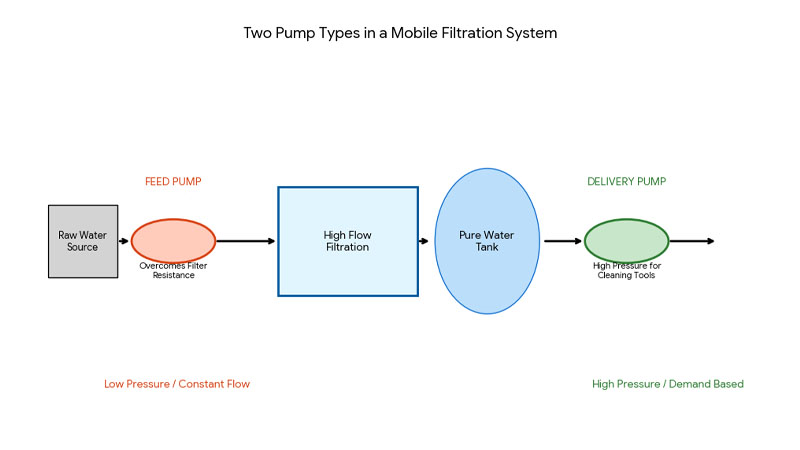
A common mistake is thinking you only need one pump. A professional high-flow system requires at least two distinct pumps, each designed for a very different job. Using the wrong pump in the wrong place will lead to inefficiency and equipment failure.
The Feed Pump: Volume Over Pressure
The first pump in the system is the feed pump. Its job is simple: move a high volume of source water from your tank or pond and push it through your High-Flow pre-filter and into the RO system. This pump does not need to create high pressure. It just needs to provide enough flow to keep the RO system supplied with water and overcome the small pressure drop from the filters. A simple centrifugal pump is often perfect for this role.
The Delivery Pump: Pressure is Key
The second pump comes after your pure water buffer tank. This is your delivery pump, and its job is all about pressure. It needs to take the pure water and push it through hundreds of feet of hose, up the height of the solar arrays, and still have enough pressure left at the nozzle for effective cleaning. This almost always requires a multi-stage centrifugal pump, which is specifically designed to generate high pressure. Trying to use a simple feed pump here would result in a weak trickle of water at the end of the hose.
| Pump Type | Primary Job | Typical Pressure | Typical Flow Rate |
|---|---|---|---|
| Feed Pump | Move source water through pre-filters | Low (40-60 PSI) | Matches RO system’s need |
| Delivery Pump | Send pure water to cleaning tools | High (100-300+ PSI) | Matches peak cleaning demand |
How should the system be laid out on a trailer?
You have all your components, but how do you fit them on a trailer? A chaotic layout makes simple maintenance impossible and can create an unbalanced, unsafe trailer.
Design the layout for logical water flow and easy maintenance. Place heavy tanks over the axles for balance, and ensure filter housings and pumps are easily accessible for service without needing to remove other components.
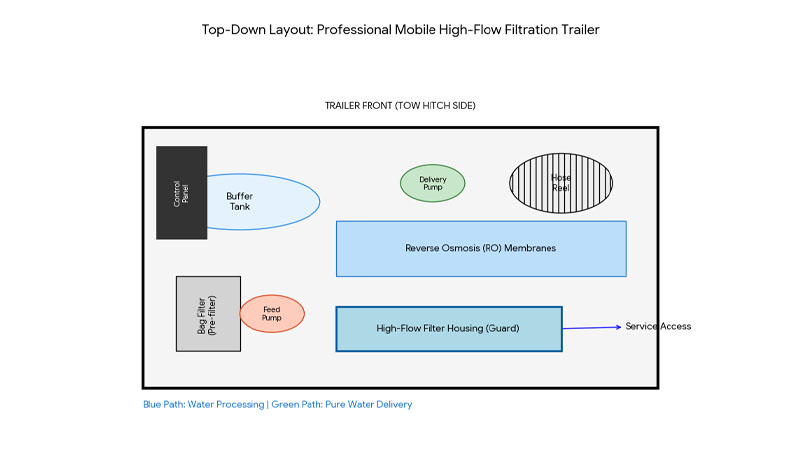
The physical layout of the components on your truck or trailer is just as important as the components themselves. A smart layout makes the system safe to transport, easy to operate, and simple to maintain. A poor layout is a constant source of frustration.
Prioritize Weight Distribution
Safety comes first. The heaviest items in your system will always be the water tanks. A 200-gallon tank full of water weighs over 1,600 pounds. These tanks must be placed directly over the trailer’s axles. Placing heavy weights too far forward or too far back can make the trailer dangerously unstable to tow.
Design for Access and Maintenance
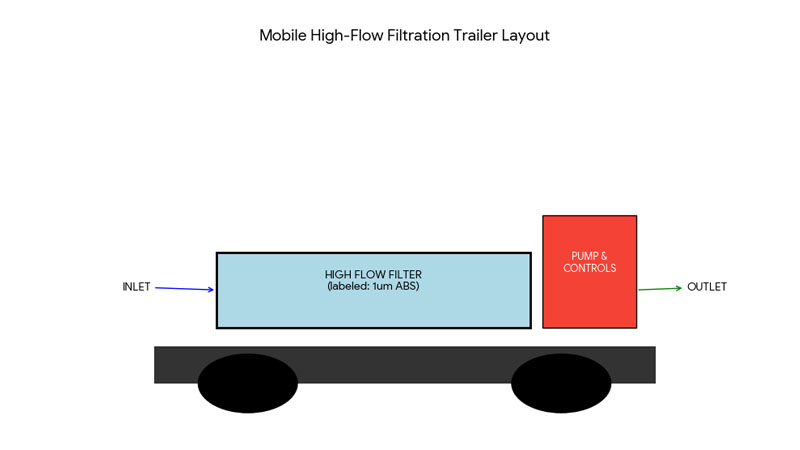
I have seen systems where the High-Flow filter housing was crammed in a corner, making it impossible to open without first unbolting a pump. This is a terrible design. When you lay out your components, imagine you need to service each one. Leave clear space around pumps, motors, and especially filter housings. I always recommend mounting filter housings at a comfortable waist height. This makes changing a heavy cartridge much easier and safer for the operator.
Follow the Water’s Path
The most logical layout follows the path of the water. Arrange your components in a line: source water inlet, feed pump, High-Flow pre-filter, RO system, pure water buffer tank, delivery pump, and finally the hose reels and outlet. This makes the plumbing shorter, more efficient, and much easier to troubleshoot if a problem occurs.
Conclusion
Proper system design requires calculating demand, selecting correct components, and planning a smart layout. This systematic approach is the key to building a reliable and profitable cleaning system.