How significant is the impact of red tides (algal blooms) on desalination pretreatment systems? How can high-flow-rate filter cartridges cope?
Your desalination plant runs perfectly for months, then you see it: a strange reddish-brown stain spreading across the ocean. Soon, alarms are screaming as your entire pretreatment system collapses under a biological assault.
The impact of a red tide is catastrophic. It overwhelms the system with a massive load of algae cells, sticky organic byproducts, and toxins. This rapidly clogs all stages of pretreatment, from media filters to security cartridges, threatening a complete plant shutdown.
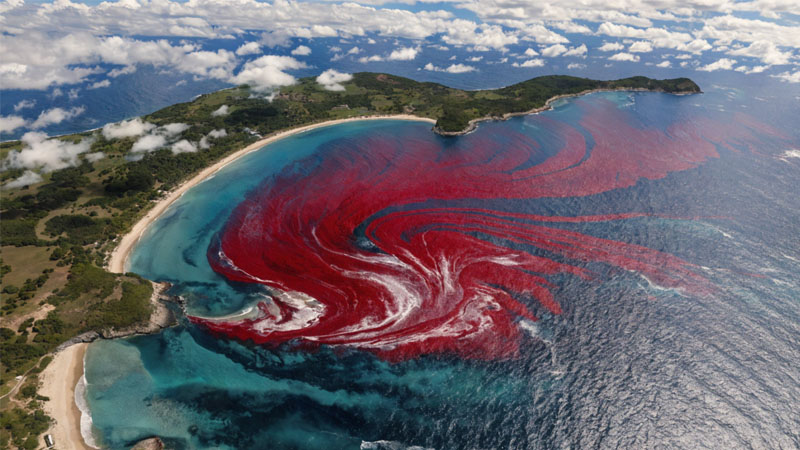
I once got an emergency call from a plant manager on the coast of Florida. His voice was full of stress. He said, "Doris, it’s like the ocean is bleeding, and it’s killing my plant." A massive red tide had appeared almost overnight. His Dissolved Air Flotation (DAF) units were overwhelmed, his media filters were blinding in a few hours instead of a few days, and his security filters were failing in under an hour. The sheer scale of the biological invasion was something his system was never designed to handle. It was a powerful lesson that in desalination, you are always at the mercy of the raw water source, and nature can throw curveballs that push even the best-designed systems to their breaking point.
What exactly makes a red tide so devastating to pretreatment systems?
You see the discolored water, but it looks like just another dirty water event. You soon realize this is a completely different kind of challenge that your normal procedures can’t handle.
A red tide is a triple threat: it brings an overwhelming number of physical particles (the algae), a flood of dissolved sticky goo that fouls surfaces, and sometimes, potent biological toxins that can damage RO membranes.
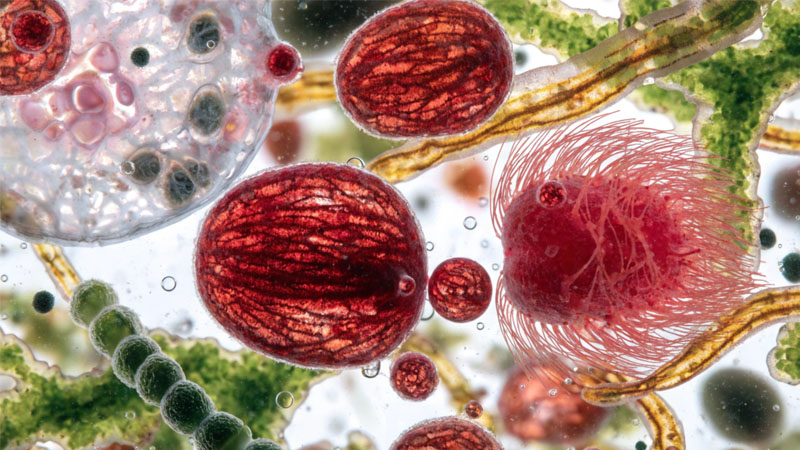
A red tide event is much more complex than a simple increase in silt or sediment. It attacks a pretreatment system on three different fronts at once.
1. Massive Particulate Load
An algal bloom can contain millions of individual algae cells per liter of water. This is an enormous physical load. The sheer number of these microscopic particles is enough to rapidly clog any filter in their path. They are also fragile. They can break apart under pressure, creating even smaller fragments that are harder to remove.
2. High Organic Content
Algae release sticky organic compounds known as Extracellular Polymeric Substances (EPS) and other forms of Total Organic Carbon (TOC). This dissolved "goo" is a huge problem. It coats surfaces, making them slimy and hard to clean. It also interferes with coagulation and flocculation, the chemical processes designed to clump particles together so they can be removed.
3. Potential Toxicity
Some species of algae produce toxins. These are dissolved chemical compounds that cannot be removed by physical filtration. If they reach the RO membranes, they can cause irreversible damage or even pass through into the final product water, posing a health risk.
| Threat | Description | Impact on System |
|---|---|---|
| Particulate Load | Millions of algae cells per liter | Rapidly clogs filters and surfaces |
| Organic Content (EPS/TOC) | Sticky dissolved biological goo | Fouls surfaces, disrupts coagulation |
| Toxins | Harmful dissolved chemicals | Poisons RO membranes, contaminates product |
How do traditional pretreatment methods fail during a red tide?
Your pretreatment system, including coagulation and media filtration, has worked reliably for years. Suddenly, during a red tide, it completely fails, letting a flood of contaminants through to your security filters.
Traditional systems are designed for a predictable range of contaminants. A red tide is an extreme event that overloads every stage. Coagulants are consumed by organic matter, clarifiers can’t handle the biomass, and media filters blind almost instantly.
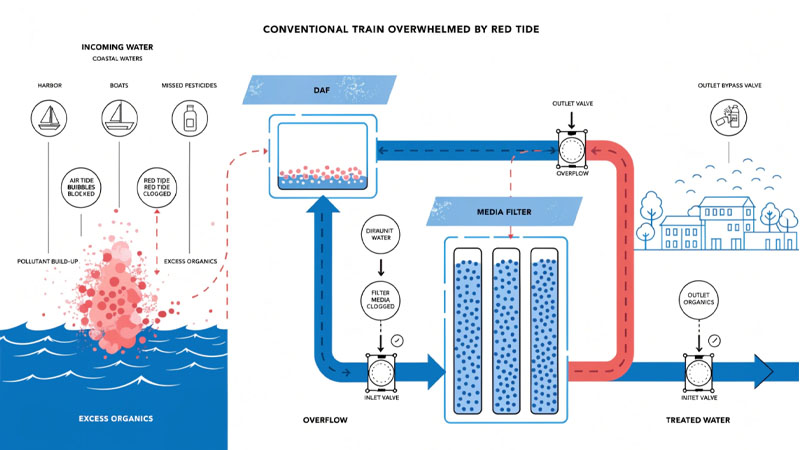
A conventional desalination pretreatment train is a series of steps designed to work together. A red tide causes a cascading failure through this entire chain. It starts with the coagulation and flocculation stage. The massive amount of organic matter in the water consumes the coagulant chemicals, preventing them from forming effective flocs. The flocs that do form are often weak and small. These weak flocs then move to the next stage, typically a Dissolved Air Flotation (DAF) unit or clarifier. These units are not designed for such a huge volume of biomass, so a large portion of the algae and organic material passes right through. This untreated flood of contaminants then slams into the dual media filters (DMF). The media filters, which are supposed to polish the water, are hit with a load they were never meant to see. Their surfaces are quickly blinded by a combination of algae cells and sticky EPS, causing the pressure to spike and forcing frequent, wasteful backwashing cycles. The system simply cannot keep up.
Where do high-flow cartridges fit into the red tide defense strategy?
Your main pretreatment is failing, and a torrent of algae and organic material is heading directly for your RO membranes. You wonder if your last line of defense, the security filters, stands any chance.
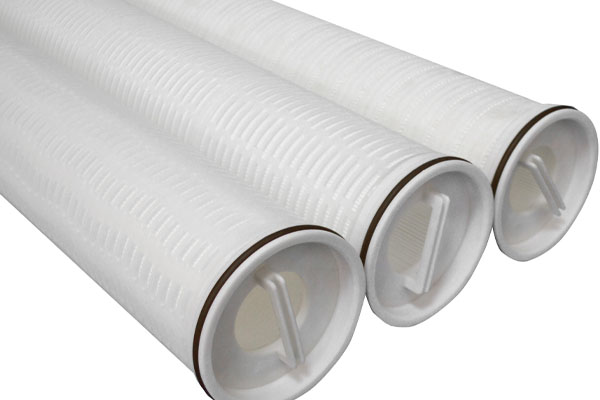
High-flow cartridges serve as a critical, sacrificial last line of defense. Their massive surface area and depth-loading capacity allow them to absorb the huge influx of particles that break through the primary pretreatment, protecting the RO system from catastrophic failure.
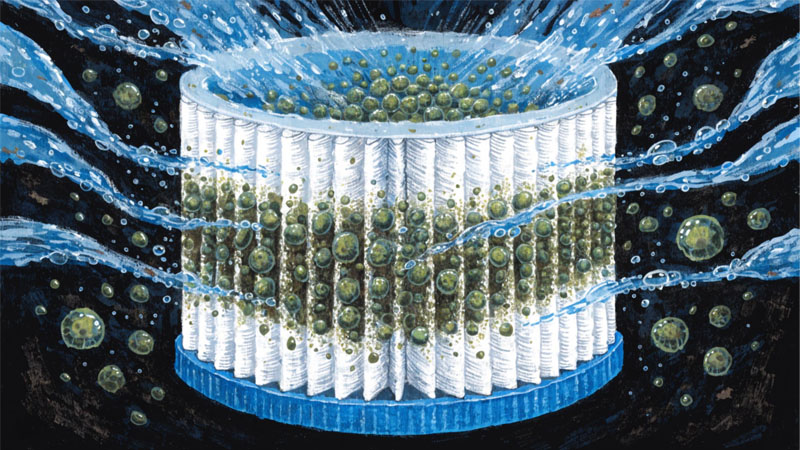
During a red tide, the role of the security filter changes from a simple "policeman" to a frontline soldier. This is where high-flow cartridges prove their value. They are not a magic solution to the entire problem, but they are an essential damage control tool. Their effectiveness comes from their unique design. The large diameter and deeply pleated media provide an enormous surface area. This allows them to capture a massive number of algal cells before the differential pressure rises to its limit. This is known as high dirt-holding capacity. I’ve seen situations where standard 2.5-inch cartridges would last less than 30 minutes, while a high-flow cartridge in the same service could last for several hours. This extra time is invaluable. It gives operators a window to adjust upstream processes or to plan change-outs in a more controlled way. In this scenario, the high-flow cartridge is a sacrificial component. Its job is to clog up while protecting the multi-million dollar RO membranes downstream. Their fast, easy change-out design is also a major benefit during these high-stress emergency conditions.
Conclusion
Red tides are a severe triple threat to desalination systems, capable of causing a complete shutdown. While they overwhelm traditional pretreatment, high-flow cartridges act as a crucial final shield, using their superior capacity to absorb the impact and protect the vital RO membranes.