Why Tap Water Damages Solar Panels (And How to Fix It)
You use tap water to clean your solar panels, trying to boost their efficiency. But afterward, they are covered in ugly white spots, and your power output barely improves.
Tap water contains dissolved minerals that, upon evaporating, leave a light-blocking film. This mineral scale reduces power output and can permanently damage the panel’s anti-reflective coating. The solution is to clean with purified water that leaves zero residue.
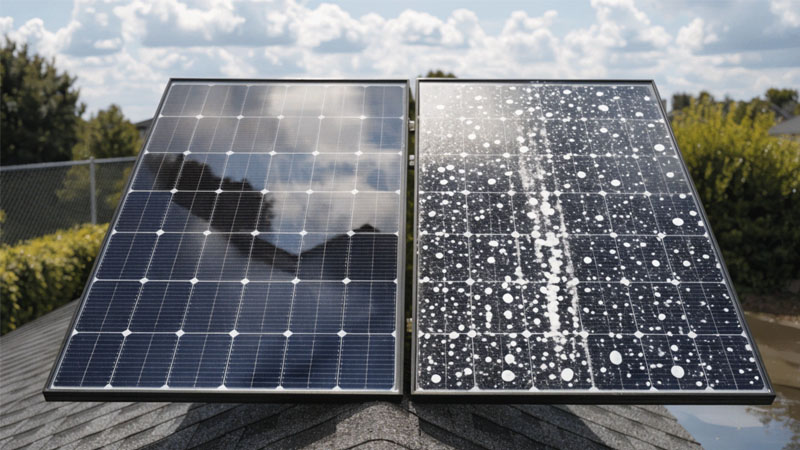
I once consulted for a large agricultural business that had installed a massive solar farm on their property. The manager was complaining that after just one year, the system’s output was already down by nearly 15%. I asked him about their maintenance schedule, and he proudly told me they hosed the panels down every month with water from their well. I immediately knew the problem. We tested their well water, and the Total Dissolved Solids (TDS) were incredibly high. They were essentially spraying a thin layer of liquid rock onto their panels, which then baked in the sun. It was a classic case of a good intention leading to a bad outcome, all because no one considered what was actually in the water.
You see the spots, but you assume it’s just dust or soap residue. In reality, the problem is invisible dissolved solids that are actively harming your long-term solar investment.
The main culprits are "hard water" minerals like calcium and magnesium, measured as Total Dissolved Solids (TDS). Other harmful contaminants include silica and chlorides, which form a tough, light-blocking scale that standard cleaning won’t easily remove.
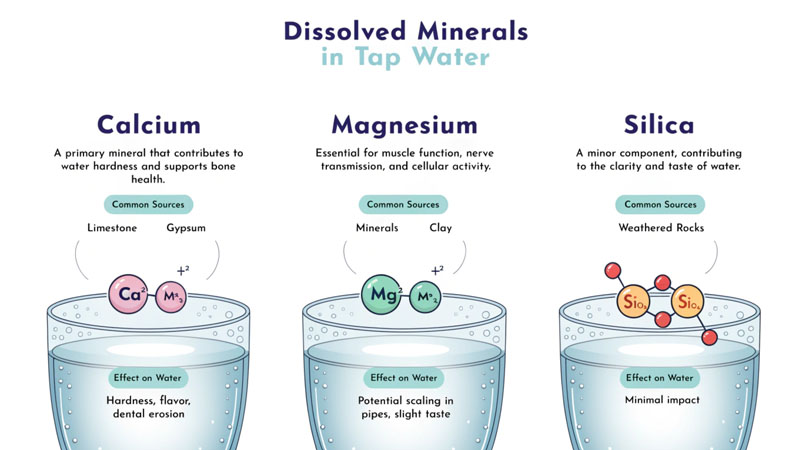
When we talk about water purity, we’re really talking about what’s dissolved in it. Tap water looks clear, but it carries a hidden load of minerals it picked up on its journey through the ground and pipes. The most common measurement for this is Total Dissolved Solids, or TDS. Think about the white, crusty scale that builds up on your shower head or inside a coffee pot—that’s TDS. On a solar panel, this effect is much worse. The sun evaporates the pure water (H₂O) very quickly, leaving behind a concentrated film of every mineral that was in it. This isn’t just dirt that can be wiped away; it’s a hard chemical deposit that bonds to the glass surface. Well water is often much worse than city water, containing higher levels of iron and silica, which create even tougher and more damaging deposits.
Common Damaging Minerals in Tap Water
| Mineral | Chemical Symbol | Type of Damage |
|---|---|---|
| Calcium Carbonate | CaCO₃ | Forms classic white, crusty limescale. |
| Magnesium Carbonate | MgCO₃ | Contributes to water hardness and scale. |
| Silica | SiO₂ | Forms a very hard, glass-like scale that is difficult to remove. |
| Chlorides | Cl⁻ | Can be corrosive to panel frames and metallic components. |
How exactly do these mineral spots reduce a panel’s power output?
You might think a few white spots are just a cosmetic issue. But even a thin, almost invisible layer of mineral film is enough to significantly slash your energy production.
Mineral spots create a shading effect, directly blocking sunlight from reaching the photovoltaic cells. They also can etch the panel’s anti-reflective coating, causing more light to bounce away instead of being absorbed, leading to a measurable drop in power.
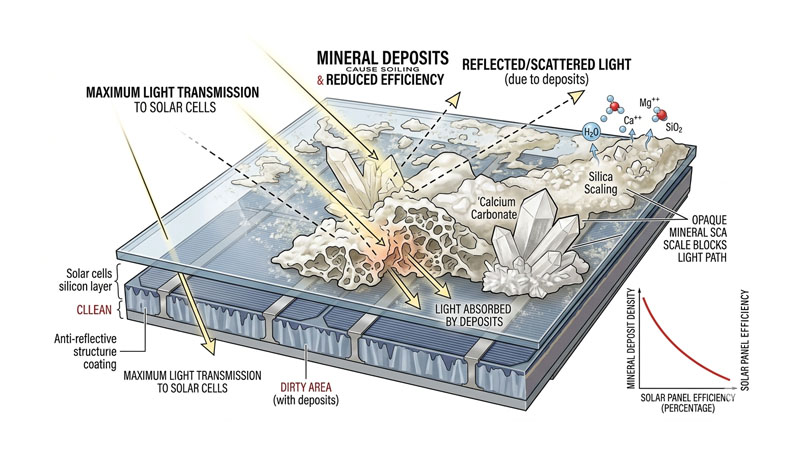
The damage from mineral scale happens in two distinct ways. The first is simple and easy to understand. The second is more subtle and much more destructive over the long term.
The Shading Effect
The most immediate problem is shading. The layer of mineral deposits is opaque, so it physically blocks photons from reaching the silicon cells that generate electricity. Think of it like putting a frosted film over the glass. Even a layer so thin that you can barely see it can scatter and block a surprising amount of light. Studies have shown that heavy soiling and scaling can reduce a panel’s output by over 20%. You paid for 100% of the panel’s surface area, but the mineral film ensures you can only use a fraction of it.
Damage to the Anti-Reflective (AR) Coating
This is the more serious, long-term problem. Solar panels are manufactured with an incredibly thin, microscopic anti-reflective coating on the glass. Its only job is to ensure that as much light as possible enters the panel instead of reflecting off. Hard water deposits are alkaline. When they sit on the AR coating and are baked by the sun, they can chemically etch and destroy this delicate layer. This damage is permanent. Once the coating is compromised, that part of the panel will forever be less efficient, even after it’s cleaned.
What is the ideal water for cleaning solar panels and how is it made?
Now that you know tap water is harmful, you need a safe and practical alternative. You can’t use bottled water, so you need a reliable, professional solution for the job.
The ideal solution is ultra-pure water with near-zero Total Dissolved Solids (TDS). This is produced using Reverse Osmosis (RO) or Deionization (DI) systems. This pure water cleans effectively and evaporates completely, leaving no spots or damaging residue.
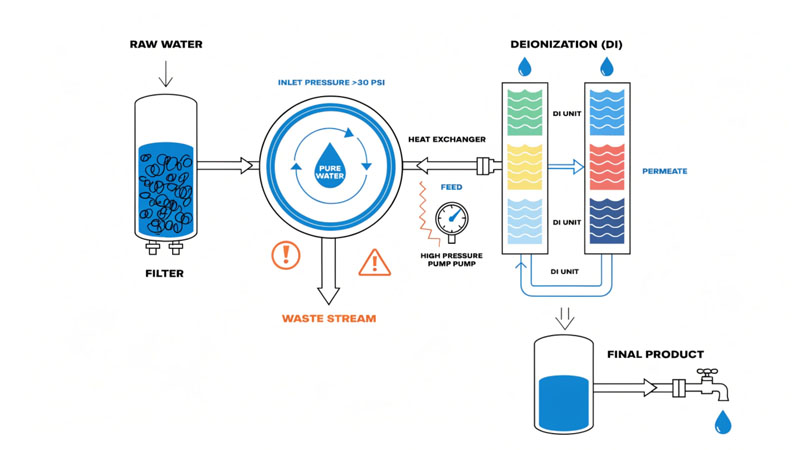
The fix is straightforward: use water that has nothing dissolved in it. When pure water evaporates, it leaves nothing behind. This is where industrial filtration technology comes in. The two most effective methods for producing this "spot-free" water are Reverse Osmosis and Deionization.
Reverse Osmosis (RO)
RO systems use high pressure to force water through a special semipermeable membrane. The water molecules can pass through, but the larger dissolved mineral ions cannot. It’s a highly effective physical filter that can remove 95% to over 99% of all TDS. An RO system is a great workhorse for producing large volumes of purified water.
Deionization (DI)
DI filtration uses a different process. It uses special resins that have positive and negative electrical charges. As water flows over these resins, they act like powerful magnets, pulling the positively and negatively charged mineral ions out of the water and exchanging them for pure water molecules. DI can produce water that is exceptionally pure, with a TDS reading of virtually zero. Professional solar panel cleaning services almost exclusively use DI or RO/DI water because it guarantees a perfect, residue-free finish.
Conclusion
Using tap water damages solar panels by leaving mineral deposits. The solution is cleaning with pure, filtered water to protect your investment and maintain maximum power output.