The TSS Matrix: How to Select the Right Filtration Strategy Based on Solid Load
The TSS Matrix: How to Select the Right Filtration Strategy Based on Solid Load
In filtration system design, TSS (Total Suspended Solids) is the number that dictates your OPEX (Operational Expenditure).
A common mistake I see in the field is engineers treating all water sources the same. They install a High Flow Cartridge housing on a stream with 200 ppm TSS and then wonder why they are changing filters every 4 hours.
That is not a filtration failure; that is a design failure.
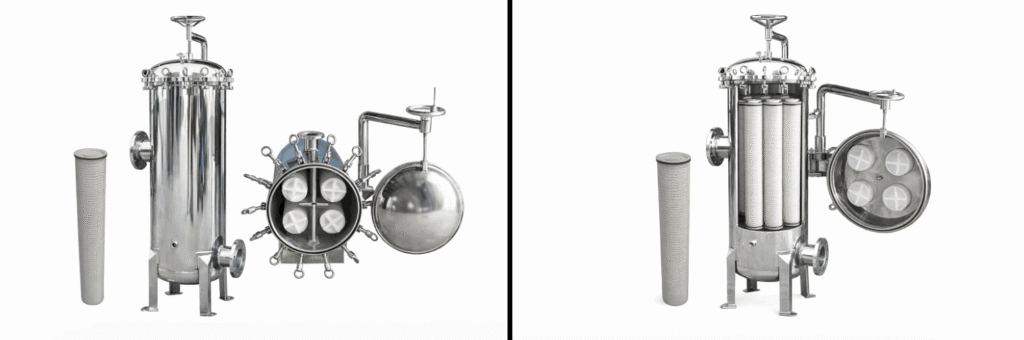
As a rule of thumb, High Flow Filter Cartridges are designed for "Polishing" and "Protection," not for "Bulk Removal."
Here is my "TSS Decision Matrix" to help you choose the right technology for the right load.
Zone 1: Low Load (TSS < 10 ppm)
The Scenario: City water, RO Pre-treatment (after sand filters), Final Product polishing.
The Strategy: Protection & Precision.
The Tech: High Efficiency Pleated High Flow Cartridges.
Here, the goal is Absolute Retention (Beta 5000). Since the dirt load is low, you don’t need to worry about rapid blocking.
Focus on tight micron ratings (1µm, 5µm) to protect downstream equipment (RO membranes/Spray nozzles) from the few rogue particles that exist.
Expected Life: Weeks to Months.
Zone 2: Medium Load (TSS 10 – 50 ppm)
The Scenario: Reclaimed water, River water (calm days), Cooling tower side-stream.
The Strategy: Capacity is King.
The Tech: Deep-Pleated or Gradient Density High Flow Cartridges.
If you use a standard surface filter here, it will "glaze over" too fast.
You need a High Flow cartridge with "Laid-Over" pleat geometry or a thick, gradient depth media. This allows contaminants to be trapped deep within the media matrix, not just on the skin.
Goal: Maximize Dirt Holding Capacity (DHC) to extend change-out intervals to an acceptable level (e.g., > 1 week).
Zone 3: High Load (TSS 50 – 100 ppm)
The Scenario: Process water, Post-reaction chemical fluids.
The Strategy: The Economic Boundary.
The Tech: Coarse High Flow Cartridges (10µm – 50µm).
We are entering the danger zone. Using fine filters (1-5µm) here is expensive.
The strategy shifts to using coarser High Flow filters to remove the "chunks" and protect downstream fine filters.
Warning: You must calculate the cost of consumables vs. the value of the product. If the fluid is valuable (e.g., amine, solvents), the cartridge cost is justified. If it’s just waste water, this might be too expensive.
Zone 4: Extreme Load (TSS > 100 ppm)
The Scenario: Raw river water (storm), Primary wastewater, Descaling wash water.
The Strategy: STOP. Do Not Use Cartridges.
The Verdict: Using disposable cartridges for this load is Economic Suicide.
High Flow cartridges are not garbage trucks. They cannot handle mud.
The Solution: You need "Regenerable" or "Bulk" separation technologies before the cartridges.
Sedimentation/Clarifiers: Use gravity (and Flocculants) to settle the heavy solids.
Multi-Media Filters (Sand/Anthracite): To knock the TSS down from 100 to < 10.
Automatic Backwashing Strainers: For continuous large particle removal.
Role of Cartridges: Only install High Flow cartridges after these stages to polish the remaining < 10 ppm.
Conclusion Filtration is a chain. If you force a High Flow cartridge to do the job of a Sand Filter, you will fail. If you use a Sand Filter to do the job of a High Flow cartridge (Precision), you will damage your downstream assets.
Know your TSS number. Respect the Matrix.
👇 Discussion: What is the highest TSS application where you successfully used cartridge filtration?