🛢️ Produced Water Injection: Why "Beta 5000" Rated Filters Are Essential for Well Protection
In Enhanced Oil Recovery (EOR) and waterflooding operations, the mandate is clear: Maintain Injectivity.
You pump produced water back into the reservoir to sweep oil towards production wells. But the reservoir rock is unforgiving. It acts as a deep-bed filter itself. If you inject suspended solids that are too large, you plug the pore throats of the formation.
Once the formation is plugged, injection pressure rises, flow rates drop, and you are faced with expensive acid stimulation jobs or hydraulic fracturing to restore the well.
This is why "Nominal" filters are no longer enough. To truly protect the reservoir, you need Beta 5000 (Absolute Rated) filtration. Here is the engineering logic behind it.
1. The "1/3 Rule" of Formation Damage
Petroleum engineering principles state that particles larger than 1/3 to 1/7 of the formation’s pore throat size will form a bridge and plug the wellbore face.
- The Risk: If your reservoir has an average pore throat size of 15 microns, you must remove particles larger than 5 microns.
- The Failure of Nominal Filters: A standard "5-micron" nominal filter acts like a screen door. It stops most 5-micron particles, but it might let 10% or 20% of larger particles (10-15 microns) pass through. Over weeks of injection, these escaped particles build up and choke your well.
2. What Does "Beta 5000" Actually Mean?
The Beta Ratio ($\beta$) is the industry standard for filtration efficiency.
$$\beta = \frac{\text{Particles Upstream}}{\text{Particles Downstream}}$$
A Beta 5000 rating means that for every 5,000 particles of a specific size entering the filter, only 1 passes through.
Efficiency: $1 – (1/5000) = 99.98\%$
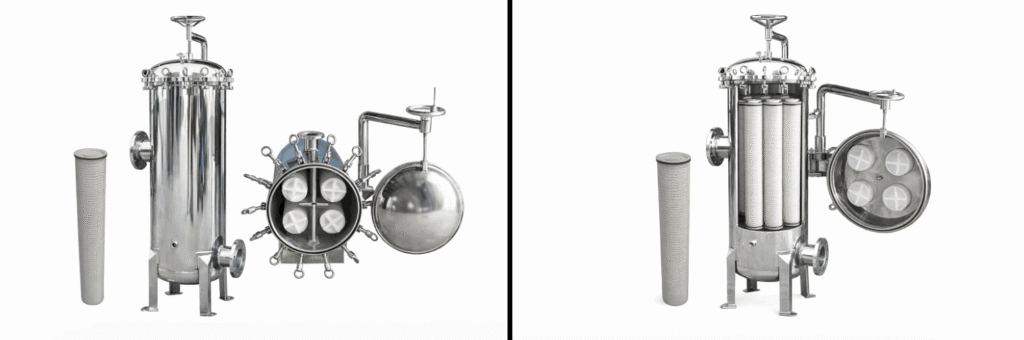
When you specify a "Beta 5000 @ 5 micron" High Flow filter, you are guaranteeing that virtually zero damaging particles enter the wellbore.
3. Handling the "Oil" Factor
Produced water often contains residual oil droplets. Standard melt-blown filters can deform or "channel" when saturated with oil.
- High Quality Solution: Beta 5000 High Flow filters often utilize rigid, pleated media with substantial surface area. This structure resists the differential pressure spikes caused by oil slugging, ensuring the pore structure doesn’t open up and dump contaminants downstream.
4. The Economics: CAPEX vs. OPEX
- Scenario A (Cheap Filters): Save $5,000 a year on consumables. Spend $150,000 on acid jobs and lost production due to downtime.
- Scenario B (Beta 5000 High Flow): Spend slightly more on filters. Benefit: Maintain stable injection rates for years without intervention.
Conclusion
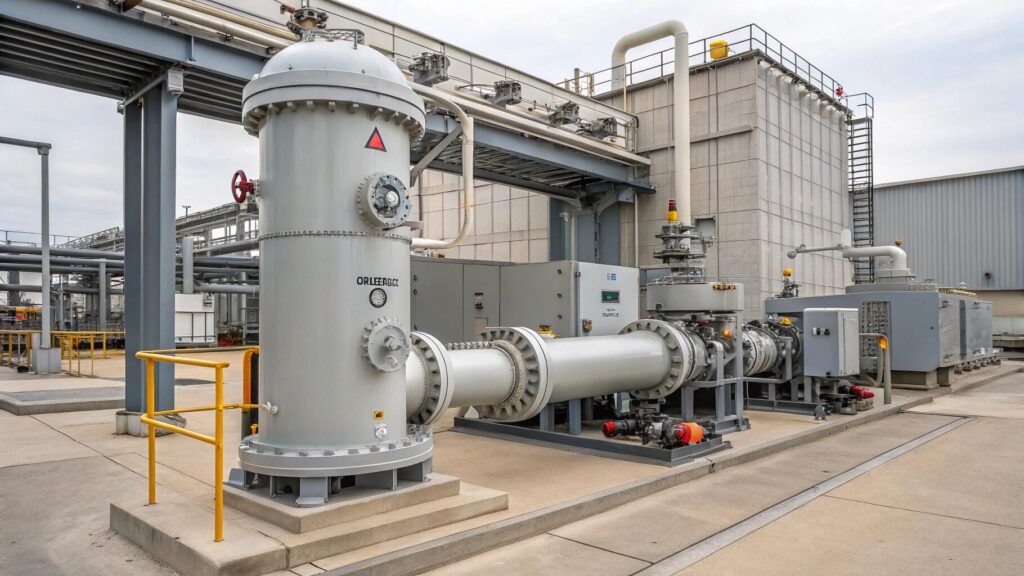
The filter housing on your injection skid is the last line of defense for your multi-million dollar asset (the reservoir). Don’t compromise with nominal ratings. If the rock needs 5 microns, give it absolute 5 microns.
👇 Discussion: What acts as your primary filtration for water injection? Walnut Shell Filters or Cartridges?