🕵️ OEM vs. Replacement High Flow Filters: The Truth About Performance, ROI, and Compatibility
In my 15+ years in the fluid filtration industry, I have sat in countless meetings with Procurement Managers and Plant Engineers facing the same dilemma:
"Do we stick with the expensive OEM (Original Equipment Manufacturer) filters to play it safe? Or do we switch to a Replacement brand to cut costs, risking a shutdown?"
It is the classic fear of the unknown.
But here is the dirty little secret of the filtration world: Many major OEMs do not manufacture their own filters. They are engineering companies, not textile weavers. They contract the manufacturing to specialized filtration factories (Private Labeling), stamp their logo on the end cap, and mark up the price by 300%.
So, are you paying for Performance, or are you paying for the Logo?
Let’s break down the technical reality of swapping to High Quality Replacements, covering the three things that actually matter: Performance, Compatibility, and ROI.
1. The Performance Test: Is the "Secret Sauce" Real?
OEM sales reps will tell you their media is "proprietary" and impossible to replicate.
The Truth: Filtration physics is not magic; it is material science.
A "Tier 1" Replacement manufacturer uses the exact same raw material suppliers as the big brands.
- Media: We source the same high-grade Polypropylene or Glass Fiber from global leaders (like H&V or Ahlstrom).
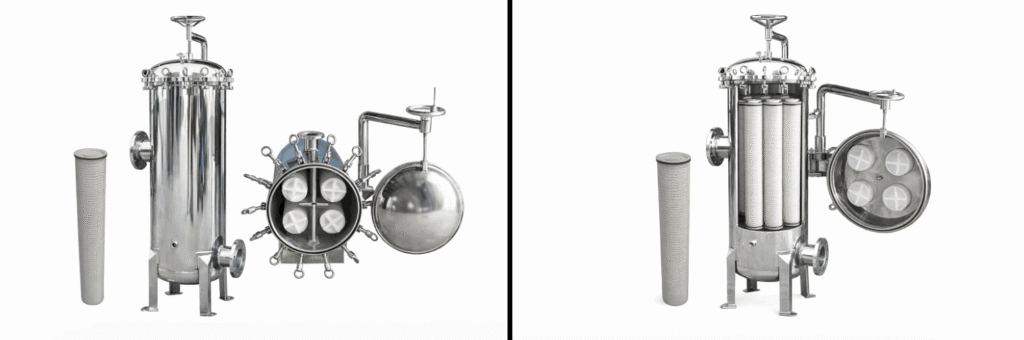
- Geometry: The "Laid-Over" or "Crescent" pleating technology—once a patent-protected secret—is now a mastered standard among top-tier manufacturers.
The Litmus Test:
If a replacement filter offers:
- Beta 5000 Efficiency (Absolute Rated)
- Comparable Surface Area (e.g., 8-10 m² per 60" element)
- Thermal Welding Construction
Then the fluid dynamics inside the housing will be identical. The water does not know which logo is on the end cap.
2. The Compatibility Fear: "Will it Fit?"
This is the legitimate fear. I have seen cheap "knock-offs" where the O-ring was 0.5mm too loose, causing bypass.
The Truth: A qualified replacement is not a guess; it is a Reverse-Engineered Precision Part.
- Parker ParMax / Pall Ultipleat / 3M High Flow: These designs are well-documented.
- The Critical Spec: It’s all about the O-ring durometer (hardness) and End Cap molding tolerance.
Insider Tip: When testing a replacement, perform the "Wet Install" test. Lubricate the O-ring. It should require a firm push to seat. If it slides in with zero resistance, send it back. If it requires a hammer, send it back. A premium replacement mimics the OEM fit perfectly (Push & Twist).
3. ROI: The "Cost Per Cubic Meter" Calculation
Let’s talk money.
- An OEM High Flow cartridge might cost $400.
- A Premium Replacement might cost $150.
Even if the OEM lasts 10 weeks and the Replacement lasts 9 weeks (due to slight variations in media volume), let’s do the math:
- OEM: $40 / week.
- Replacement: $16.6 / week.
The Result: You save 58% on OPEX even with slightly shorter life.
However, in my experience, a Premium Replacement with equivalent surface area often matches or exceeds OEM life because specialized manufacturers focus solely on optimizing that specific SKU.
4. How to Spot a "Bad" Replacement (The Red Flags)
Not all replacements are created equal. This is where you need to be vigilant. To protect your system, avoid suppliers who:
🚩 Use Glues: If you see yellow adhesive on the end caps, run. It must be Thermally Welded.
🚩 Cannot Provide Beta Curves: If they can’t show you a multipass test report, they are guessing the efficiency.
🚩 Light Weight: Weigh the OEM filter vs. the Replacement. If the replacement is 30% lighter, they stole the media area.
Conclusion: Trust Data, Not Boxes
The era of being held hostage by OEM consumables is over.
If you are a Plant Manager, your loyalty should be to your OpEx Budget and your Water Quality, not to a brand name.
By validating a Tier 1 Replacement Manufacturer—one who understands pleat geometry, thermal bonding, and Beta ratings—you can achieve the exact same system protection at a fraction of the cost.
Don’t buy "Cheap." Buy "Equivalent." There is a massive difference.
👇 Discussion: Have you ever switched from OEM to aftermarket? What was your biggest surprise (good or bad)?