🧶 Is Your Textile RO System Clogged by "Dirt" or by "Cotton"? The Invisible Fiber Threat
In Textile Dyeing & Printing wastewater reuse projects, the RO membranes often foul at an alarming rate.
Operators usually run a standard CIP (Cleaning In Place). They use Alkali to wash organics and Acid to wash scale.
But the Pressure Drop (△P) doesn’t go down.
Why?
Because you are trying to dissolve "Cotton" with caustic soda. It won’t work.
As a veteran in textile water treatment, I see this mistake constantly. Plants focus on removing COD and Silt, but they let the Micro-fibers (Lint) pass through.
Here is why "Fiber Fouling" is different from "Dirt Fouling," and how to stop it before it kills your RO.
1. The Anatomy of Failure: "Spacer Bridging"
Standard dirt (Silt/SDI) creates a cake layer on the membrane surface.
Fibers do something much worse.
RO membranes have a Feed Spacer (a plastic mesh) between the leaves to create turbulence.
- The Mechanism: Micro-fibers (cotton/polyester) get caught on the cross-points of this mesh.
- The Result: They create a "Bridge" or a "Net."
- The Scaffold Effect: Once this fiber net is formed, it catches every other particle (bacteria, silt, colloids) that would normally pass through.
- The Impact: You get a massive △P spike that happens exponentially faster than normal fouling.
2. Why Standard Filters Fail on Fibers
Most plants use cheap 5-micron Melt-Blown (PP) filters as security filtration.
This is a mistake for textile water.
- The "Pin-Cushion" Effect: Melt-blown PP is soft. Under pressure, rigid fibers act like needles. They pierce through the depth of the filter media and migrate downstream.
- Unloading: As the filter blocks, the differential pressure pushes the trapped fibers through the backside. You think the water is clean, but you are feeding millions of micro-fibers into the High Pressure Pump.
3. Diagnosing the Problem
How do you know if it’s Fiber or Dirt? The "Tweezers Test" (Autopsy).
- Sacrifice an old RO element. Cut it open.
- Unroll the membrane leaves.
- Look at the plastic mesh (spacer).
The Verdict: If you can pull off "fuzz" or little clumps of material with tweezers that don’t dissolve in water, it’s Fiber. If it’s just slime, it’s Biofouling.
4. The Solution: Surface Filtration & Backwashing
To stop fibers, you need to change your filtration philosophy.
Stop using Depth Filters (Melt-blown). Fibers penetrate depth.
Start using Surface Filters (Pleated).
- The Strategy:
- Upstream: Install an Automatic Backwashing Disc Filter or Screen Filter (20um – 50 um) to catch the bulk lint.
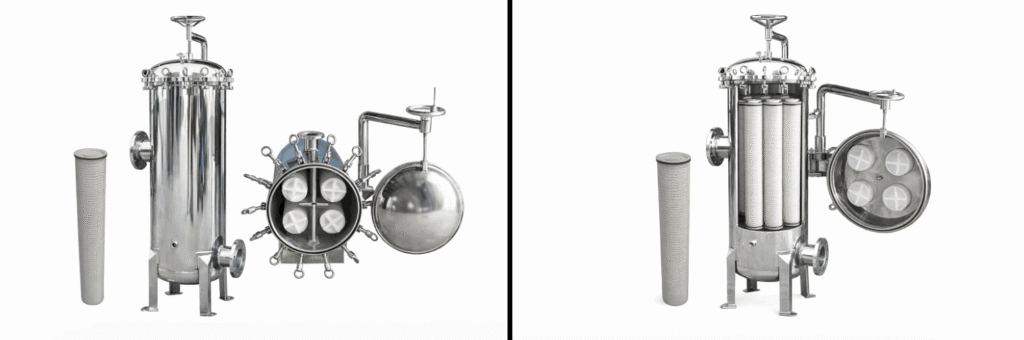
- Security Filter: Upgrade to High Flow Pleated Cartridges. The pleated surface acts as a barrier. Fibers form a mat on the outside surface but cannot penetrate.
- Rigidity: Use Rigid Media (Phenolic impregnated or reinforced) that won’t distort under pressure.
Conclusion
You cannot "Clean" fibers out of an RO membrane. Once they are wedged in the spacer, they are there forever.
The only cure is Prevention.
If you run a textile plant, stop worrying about the Color for a second, and start worrying about the Lint.
👇 Discussion: Have you ever cut open an RO membrane and found "Cotton" inside?