🌡️ PP vs. Glass Fiber: The "Softening Point" Trap in High-Temp Refinery Loops
In a refinery, "Room Temperature" is a myth.
Process streams like Amine, Glycol, Sour Water, and Hydrocrack Feeds often run between 60°C and 120°C.
When selecting High Flow cartridges for these loops, the debate is always the same:
- "Can we just use Polypropylene (PP)? It’s cheaper."
- "Do we need Glass Fiber (GF)? It’s expensive."
Standard datasheets say PP is good up to 82°C (180°F).
But here is the Veteran’s Warning: Just because the plastic doesn’t melt, doesn’t mean the filter works.
Here is the engineering reality of PP vs. GF when the heat turns up.
1. The "Softening Point" Trap (Why PP Fails at 80°C)
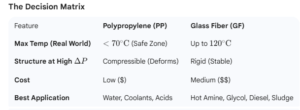
Polypropylene has a rated max temperature of 82°C.
However, as you approach this limit (e.g., at 75°C), the plastic fibers soften.
- The Failure: Under differential pressure, these softened fibers compress. The pore structure collapses.
- The Result: The filter effectively "closes up." You see a rapid spike in $\Delta P$, not because it’s dirty, but because the media has physically deformed into a solid block of plastic.
- The Verdict: Don’t use PP above 60°C – 70°C if you have high differential pressure. It’s too risky.
2. Glass Fiber: The Heat Shield (Up to 120°C)
Glass Fiber (GF) is composed of silicate fibers bonded with resin.
- The Strength: It doesn’t soften. It remains rigid and porous even at 120°C.
- The Benefit: In hot, viscous fluids (like rich amine or heavy oil), GF maintains its flow channels. You get consistent throughput without the risk of thermal collapse.
3. The "Oil" Factor (Absorption vs. Adsorption)
Temperature isn’t the only factor. Composition matters.
- PP is Oleophilic: It loves oil. In a heavy hydrocarbon stream, PP can swell and become "gummy."
- GF is Oleophilic + Porous: GF acts like a deep sponge. It can absorb significantly more hydrocarbon sludge than PP without blocking the flow.
Winner: For clean water? PP. For oily sludge? Glass Fiber.
4. The "Shedding" Myth
Clients often fear GF because of "Fiber Migration" (glass bits going downstream).
- The Truth: This was a problem 20 years ago.
- Modern Tech: High-quality GF cartridges today use an Acrylic or Phenolic Binder and a downstream Laminated Scrim (polyester layer). This locks the fibers in place. If you buy from a reputable manufacturer, fiber shedding is zero.
Conclusion
If your process runs above 80°C, stop trying to save money with Polypropylene. You are just melting plastic filters.
Switch to Glass Fiber. The extra cost is paid back by the extended life and process stability.
👇 Discussion: Have you ever seen a PP filter "shrink" or deform after being pulled from a hot Amine unit?