🕵️ Why Do Your High Flow Filters Clog Faster? (5 Hidden "Traps" in Cheap Cartridges)
We hear this story every week:
"I bought a cheaper alternative High Flow filter. The specs looked the same on paper. But it only lasts half as long as the premium brand."
Why? Is it the water quality? Usually, no.
It is the Hardware.
As a veteran in the filtration industry, I’m going to pull back the curtain on how some manufacturers cut costs to offer that "low price." These 5 hidden manufacturing shortcuts are exactly what kills your filter life and drives up your Total Cost of Ownership.
Trap 1: The "Phantom" Filtration Area (Stealing Material)
- The Claim: "6-inch diameter, High Flow capable."
- The Reality: The most expensive part of a filter is the media. To cut costs, some makers reduce the pleat depth or the number of pleats.
- The Consequence: From the outside, the cartridge looks standard. But inside? It might have 30-40% less surface area than a premium filter.
- Less Area = Higher Flux Density (velocity per square cm).
- Higher Flux = Particles impact the pores harder and faster, leading to rapid "surface blinding" and premature clogging.
- The Check: Weigh the filter. A significantly lighter filter often means less media.
Trap 2: "Nominal" Disguised as "Absolute" (The Efficiency Lie)
- The Claim: "5 Micron Efficiency."
- The Reality: Without a specified Beta Ratio (e.g., Beta 5000), "5 micron" is meaningless. Cheap filters are often Nominal (60-80% efficiency) but sold as replacements for Absolute (99.98%) filters.
- The Consequence:
- If it’s too loose: Dirt passes through, fouling your RO membranes (Expensive!).
- If it lacks Gradient Depth: Cheap media has a uniform pore structure. It acts like a screen door—blocking instantly on the surface. Premium "Absolute" filters use Gradient Density (loose outer layers, tight inner layers) to hold dirt throughout the depth, lasting much longer.
Trap 3: Recycled Materials & Glue Bonding (The Structural Risk)
- The Claim: "Polypropylene Construction."
- The Reality: Instead of Virgin PP and Thermal Welding, some use Regrind (Recycled) PP and Glues/Adhesives to attach the end caps.
- The Consequence:
- Recycled PP: Weaker structural integrity. It can crack under pressure.
- Glue: Adhesives can degrade in hot water or chemical solvents, leading to leaching (foam) or catastrophic bypass when the end cap pops off. Thermal welding is the only industrial standard.
Trap 4: The Fragile Center Core (Collapse Hazard)
- The Claim: "Withstands 3.0 Bar Delta-P."
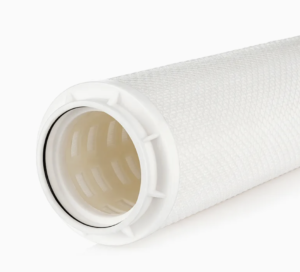
- The Reality: The center core is the skeleton. Cutting costs here involves using thinner walls or cheaper resin.
- The Consequence: As the filter does its job and pressure rises, a weak core cannot support the load.
- The Result: The core buckles or twists, causing the filter media to implode. This not only stops flow but can release all captured dirt downstream in a single burst.
Trap 5: O-Ring Dimension Deviations (The Silent Leak)
- The Claim: "Fits Standard Housings."
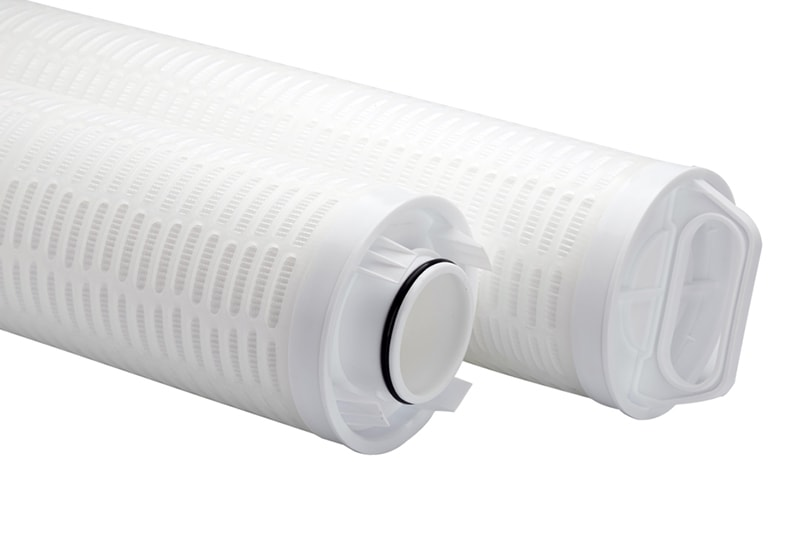
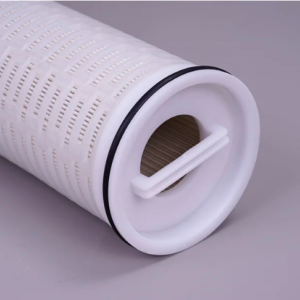
- The Reality: High Flow housings require precise tolerances. Cheap molds often produce end caps with slight deviations, or use poor-quality O-rings that lack elasticity (Compression Set).
- The Consequence: Even a 0.5mm gap or an O-ring that flattens out means Bypass.
- Water takes the path of least resistance. It flows around the filter, not through it. Your pressure drop stays low (because you aren’t filtering anything!), leading to a false sense of security until your downstream equipment fails.
—
Conclusion
There is no magic in manufacturing. If a filter is 30% cheaper, the material has to come out of somewhere.
You aren’t paying for the plastic; you are paying for the Dirt Holding Capacity and the Reliability.
Don’t let a "Cheap" filter become an "Expensive" problem.
👇 Discussion: Have you ever experienced a collapsed filter core? What was the Delta-P when it happened?