📐 The Geometry of Efficiency: How Pleating Technology Defines High Flow Performance
In industrial filtration, Surface Area is King.
The equation is simple: More Surface Area = Lower Flux Density = Longer Service Life.
But here lies the engineering challenge: How do you pack 8 to 10 square meters of filter media into a single 6-inch diameter cartridge without restricting flow?
The answer lies not just in the material, but in the Geometry of the Pleat.
Standard vertical pleating works for small filters, but for High Flow applications, we use a superior design known as "Laid-Over" (or Crescent) Pleating. Here is how it works and why it outperforms traditional designs.
1. The Problem with Standard "Fan" Pleats
In a standard 2.5-inch cartridge, the media is folded like a paper fan (radial pleats).
- The "V" Shape Limitation: As the pleats converge towards the center core, they get crowded. The media is pinched tight at the inner root.
- Dead Space: This crowding creates "Dead Zones" near the core where water cannot flow effectively. You lose up to 30% of your theoretical filtration area.
- Structural Weakness: Under high pressure, these vertical pleats can bunch together or collapse, blocking flow further.
2. The Innovation: "Laid-Over" Pleating Technology
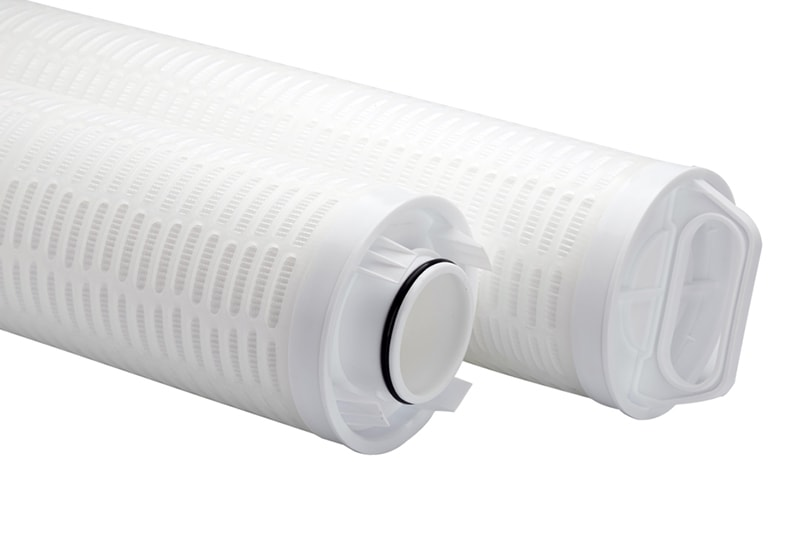
High Quality High Flow cartridges utilize a proprietary Laid-Over design. Instead of standing up vertically, the pleats are engineered to lay sideways, wrapping around the core in a spiral or crescent pattern.
- Uniform Utilization: Because the pleats lay flat, there is no crowding at the core. The spacing between pleats remains constant from the outer edge to the inner core.
- Maximizing Density: This geometry allows us to pack 40-50% more surface area into the same volume compared to vertical pleats.
- Hydraulic Advantage: The water flows through the media bank perpendicularly, utilizing 100% of the available surface area. There are no dead zones.
3. Why "Flux Density" Matters
Why do we fight for every square centimeter of area? To reduce Flux.
$$Flux = \frac{\text{Flow Rate}}{\text{Surface Area}}$$
- Lower Flux: By increasing the area via Laid-Over technology, we slow down the velocity of water as it passes through the media fabric, even if the total system flow is massive (100 m³/h).
- The Benefit: Lower velocity means particles are trapped gently. They don’t get impacted into the pores at high speed, which prevents premature "surface blinding" and drastically extends the filter’s life (DHC).
4. Structural Rigidity
Laid-over pleats form a solid, rigid cylinder.
Unlike loose vertical pleats that can move and fret, the laid-over structure supports itself. It can withstand high differential pressures without the pleats collapsing, ensuring consistent performance from start to finish.
Conclusion
Not all "Big" filters are High Flow filters. True High Flow performance comes from the sophisticated geometry inside.
When selecting a cartridge, look at the cross-section. If it uses Laid-Over Technology, you are buying maximized surface area and lower operational costs.
👇 Discussion: Have you ever cut open a used filter to see how the pleats behaved under pressure?