What Is a High Flow Filter Cartridge and How Does It Work?
Are your traditional filter housings taking up too much space and requiring too many change-outs? This leads to high capital costs, excessive labor, and inefficient filtration for large-volume processes.
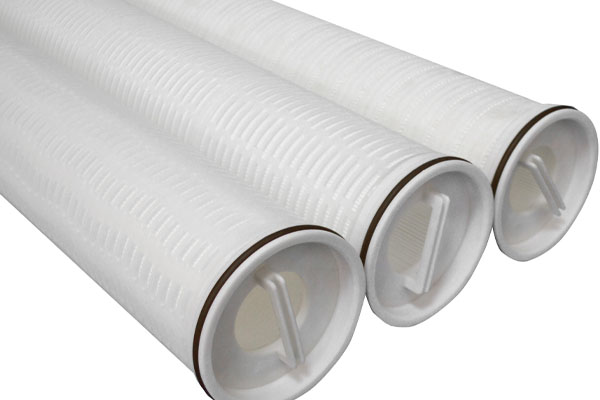
A high flow filter cartridge is a large-diameter, pleated filter designed to handle significantly higher flow rates than standard cartridges. It works by combining a large surface area with an inside-to-outside flow path, allowing a single cartridge to replace multiple smaller ones.
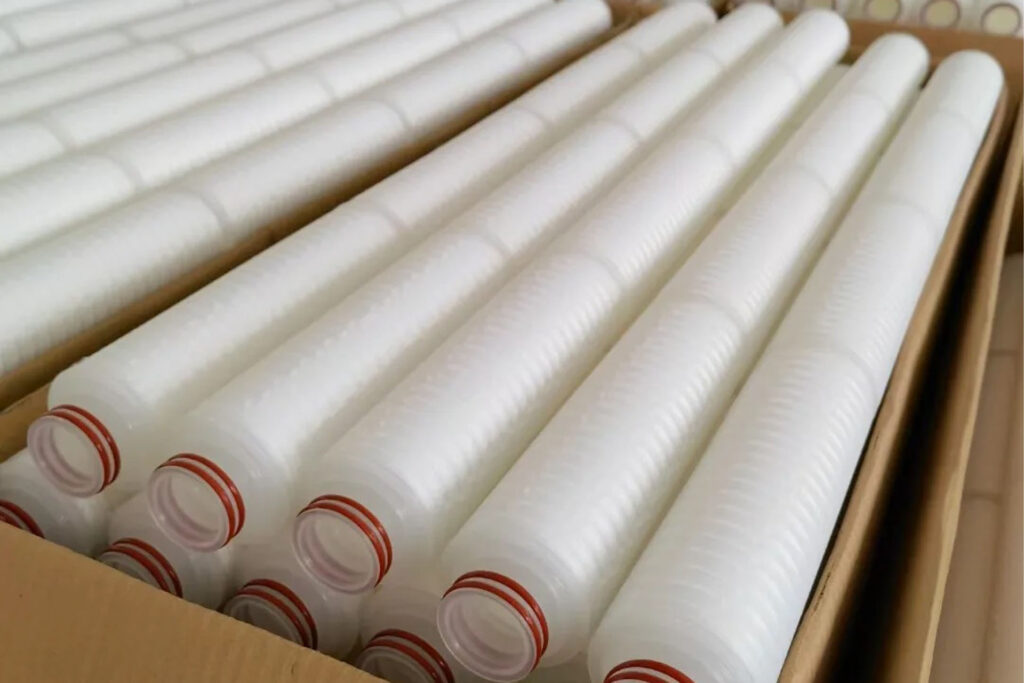
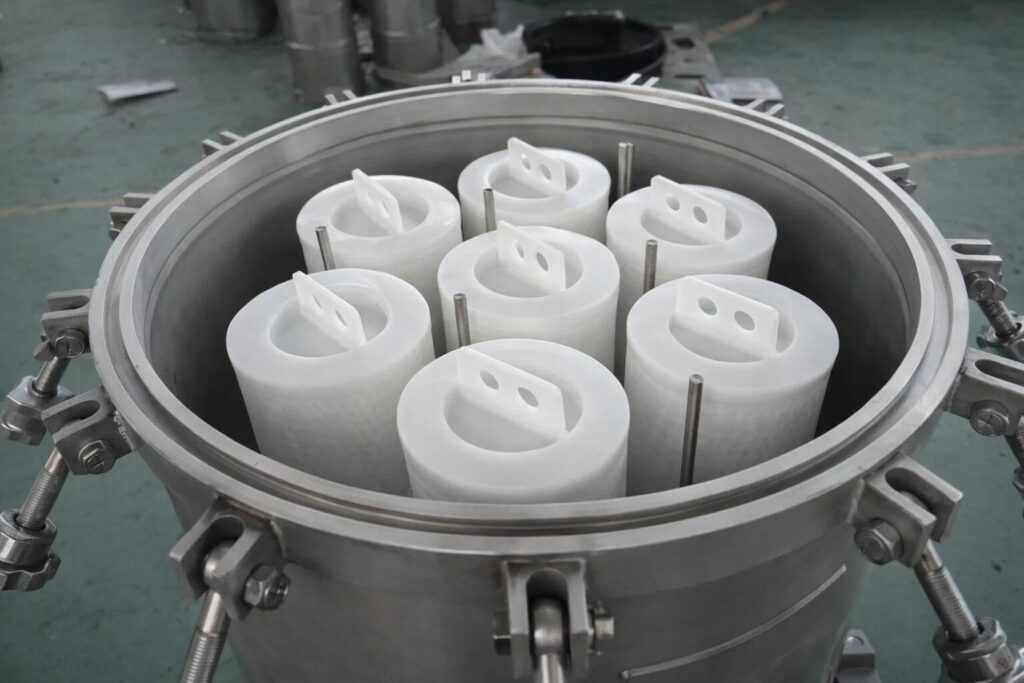
The first time I saw a high flow system in action, I was struck by its simplicity. A single large housing was doing the work that would have previously required a dozen smaller ones. For engineers like me, who are always looking for ways to make things more efficient, this was a major breakthrough. These filters aren’t just bigger; they are designed from the ground up for performance. By using a large-diameter pleated design, they can handle massive volumes of liquid with fewer components and a much smaller footprint. This changes how we can design and operate large-scale water treatment systems.
What Are the Top 5 Benefits of Switching to High Flow Filter Cartridges?
Are your filtration operational costs spiraling out of control? High labor costs for change-outs and large, expensive systems can put a huge strain on your budget.
The top benefits are a smaller system footprint, faster and easier change-outs, lower capital and operational costs, higher dirt-holding capacity, and a reduced risk of leaks. These advantages combine to create a more efficient and cost-effective filtration process.
When I talk to plant managers like Jacky, the conversation often turns to reducing costs without sacrificing quality. High flow filter cartridges directly address this need. The benefits are not just theoretical; they translate into real-world savings and improved operations. I’ve seen these benefits firsthand in applications ranging from RO pre-filtration to industrial process water.
A Breakdown of the Advantages
Let’s look at why making the switch is so compelling.
| Benefit | Description | Impact on Your Operation |
|---|---|---|
| Smaller Footprint | One high flow cartridge can replace 10 or more standard 2.5" cartridges. | Reduces the size and cost of filter housings, saving valuable plant space. |
| Faster Change-outs | Fewer cartridges to handle means significantly less time spent on maintenance. | Lowers labor costs and reduces system downtime. |
| Lower Capital Cost | Fewer housings and cartridges are needed to achieve the same flow rate. | Reduces the initial investment required for a new filtration system. |
| High Dirt-Holding | The large pleated surface area can hold more contaminants before clogging. | Extends filter life, leading to fewer purchases and less waste. |
| Fewer Seal Points | A system with one cartridge has fewer potential leak points than one with ten. | Increases system reliability and reduces the risk of process fluid loss. |
I once helped a desalination plant retrofit their pre-filtration system. By replacing their massive bank of 200 standard cartridges with just 20 high flow cartridges, they cut their change-out time from eight hours to under one hour. The savings in labor alone were huge.
How Do You Choose the Right Micron Rating for a High Flow Filter?
Are you unsure which micron rating to select for your high flow system? Choosing incorrectly can lead to poor filtration performance or filters that clog almost instantly.
Select the micron rating based on the filtration goal. For protecting sensitive downstream equipment like RO membranes, an absolute-rated 5-micron filter is standard. For less critical applications or initial pre-filtration, a 10 or 20-micron rating may be more cost-effective.

Choosing the micron rating for a high flow filter follows the same logic as for any other filter, but the stakes are higher because the volumes are so much larger. A wrong choice can have a big impact on your operational efficiency and costs. The key is to clearly define what you need the filter to accomplish.
Absolute vs. Nominal Ratings
First, it is crucial to understand the difference between "absolute" and "nominal" ratings, especially in high flow applications.
- Absolute Rating: An absolute-rated 5-micron filter will remove at least 99.9% of particles that are 5 microns or larger. This provides a guaranteed level of protection. I always recommend absolute-rated filters for critical applications, like protecting RO membranes.
- Nominal Rating: A nominal-rated 5-micron filter might remove 85% or 90% of particles at that size. It’s less precise and should only be used for general-purpose filtration where the exact particle size is not critical.
Matching the Rating to the Job
Once you’ve decided on absolute or nominal, you can pick the number. In my experience with large-scale water treatment, the most common setup is using a 5-micron absolute-rated high flow cartridge as the final guard for an RO system. This provides the perfect balance of protection without clogging too quickly. If the incoming water is very dirty, we might put a 20-micron filter upstream to act as a pre-filter, taking the heavy load off the final 5-micron filter. This two-stage approach often gives the lowest total cost of filtration.
Why Does Flow Rate Matter in High Flow Filtration?
Are you trying to push too much liquid through a single cartridge? Exceeding a filter’s recommended flow rate can force contaminants through the media and lead to poor water quality.
Flow rate matters because it directly impacts filtration efficiency and filter lifespan. Operating at the manufacturer’s recommended flow rate ensures particles are captured effectively. Exceeding it can reduce efficiency and cause a premature increase in differential pressure.
When you have a filter labeled "high flow," it’s tempting to push as much water through it as possible. However, there’s a limit. Every filter cartridge has an optimal flow rate range where it performs best. Think of it like a speed limit on a highway. Going too fast is dangerous and inefficient.
The Relationship Between Flow, Velocity, and Efficiency
The "flow rate" is the total volume passing through the filter over time (e.g., gallons per minute). The "flux" or "velocity" is how fast the liquid is moving through the filter media itself. If you push the flow rate too high, the velocity increases. When the velocity is too high, two bad things can happen. First, the force of the water can literally push particles through the filter pores that would normally be captured. This lowers your filtration efficiency. Second, the high velocity causes the pressure to build up much faster on the surface of the filter, leading to a shorter service life. I worked on a project where a client was unhappy with the short life of their filters. We checked their flow rates and found they were running them at 150% of the recommended maximum. By adding one more filter housing to distribute the flow, we brought the rate per cartridge back into the optimal range, and their filter life more than doubled.
What Are Common Signs That Your Filter Cartridge Needs Replacement?
Are you waiting for your system to fail before you change your filters? This reactive approach leads to inconsistent product quality and puts your downstream equipment at risk.
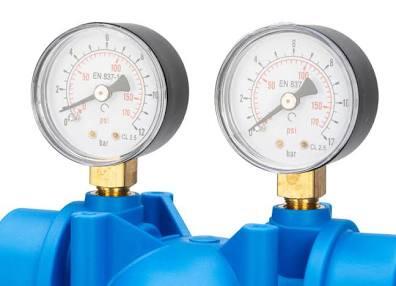
The most common sign is a high differential pressure (DP) across the filter housing. Other signs include a noticeable drop in flow rate, a decrease in final product quality, or reaching a pre-determined time-in-service limit.

Knowing when to change a filter is a critical part of running an efficient filtration system. It’s a balance between getting the most life out of each cartridge and ensuring your process is always protected. Relying on scheduled changes alone isn’t always enough; you need to let the system tell you when it’s time.
Reading the Signals
- High Differential Pressure (DP): This is the gold standard. A brand new filter will have a very low DP. As it fills with dirt, the pressure required to push water through it increases. Most operators change filters when the DP reaches a set limit, often 15-25 PSID above the clean DP. This is the most reliable indicator.
- Reduced Flow Rate: If your system is running at a constant pressure, a clogged filter will cause the flow rate to drop. If you notice you can’t meet your production targets, it’s a clear sign your filters are getting plugged.
- Poor Product Quality: This is the sign you never want to see, as it means contaminants are getting through. If you are seeing particles or cloudiness in your water after the filter, it’s either time for a change or the filter may have failed.
- Time: In some industries, like food and beverage, filters are changed on a strict time schedule (e.g., every month) regardless of the DP. This is done to prevent any potential for bacterial growth and to ensure consistent quality.
I always recommend that operators log their DP readings daily. This data helps you see the trend and predict when a change will be needed, allowing you to schedule maintenance proactively instead of reacting to a problem.
Conclusion
High flow filter cartridges offer a powerful solution for large-scale filtration, reducing costs and complexity. Proper selection and monitoring are key to unlocking their full potential for efficiency and reliability.